Technology - Myths about SIP technology
Stone and timber walls share a common drawback: high thermal conductivity, which makes it impossible to build a warm house without insulation. Today there is no technology that is ideal in every respect. That is why the arguments among supporters of different materials do not die down. All these technologies are used in low-rise construction. Choosing a material is always a compromise. So how serious are the drawbacks of a Canadian house, really?
The three topics discussed most in connection with SIP are flammability, ecology and rodents (we will look at others below as well). And only flammability really deserves serious discussion. The other two alleged drawbacks are far-fetched.
Flammability
This is the main subject of dispute between supporters of timber and brick houses. The flammability of any building material is a drawback. So why isn’t the building of individual houses from combustible materials banned?
The point is that non-combustible walls protect neither against fire nor against arson. That is a fact. Fires happen in all kinds of houses, regardless of the wall material. It is not the walls that burn. What burns is what is inside the house. According to statistics, household items catch fire ten times more often than anything else, and they are the source of fire spread. In more than 90% of cases people die from poisoning by the combustion products of what is inside buildings (furniture, carpets, interior finishes and so on). Today any residential building is like a barbecue filled to the brim with all kinds of combustible materials. Only a house is a disposable barbecue, even if its walls are made of stone.
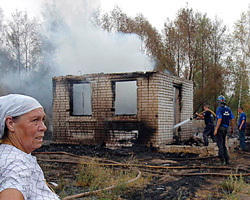
Any firefighter will confirm that a timber house is harder to put out than a stone one. But for house owners the main difference between a timber house and a brick one is that after a fire a timber house leaves a foundation and ash, while a brick one leaves a foundation and walls that must be demolished because they have lost 60-70% of their strength. The photo below shows the aftermath of the forest fires of summer 2010. What has survived here?
 |
 |
Even if firefighters manage to save the brick walls, the owner will have to redo the exterior and interior finishes, all utility systems, the timber floors, the roof structure and the roofing. And those are the main costs of building any house. The smell of the fire is absorbed into stone walls forever. The usual recommendation of specialists in this case is to demolish everything and build a new house on the old foundation.
Wall flammability matters a great deal in apartment buildings. It is a matter of people’s safety. In multi-storey buildings, smoke in the stairwell often cuts off the escape routes of people on the upper floors. Even with non-combustible walls and floors, several apartments and even whole floors often burn out in high-rises. For one- or two-storey houses the wall material is not very important. Everyone who is able to evacuate will always manage to do so before the walls and floors start to burn.
The possibility that a house may burn down frightens any normal person. The very thought that such expensive property can perish in a fire worries all new home owners at first. Over time this worry fades. People lose their vigilance. Faulty sockets appear in the house, and so on. In the vast majority of private houses and apartments you will not find an ordinary fire extinguisher, although everyone understands that it is foolish to rely solely on the fire brigade arriving. Especially in a country house. If a fire starts while you are present, an extinguisher at hand will help a thousand times more than a brick wall. It is a good idea to keep a couple of buckets ready at the dacha next to a barrel or a pit of water, and so on.
In addition to having first-line extinguishing equipment, the fire safety of any house as a whole is ensured by the following measures:
- fire protection, either structural or by treatment with fire-retardant paints or compounds;
- compliance with requirements for electrical wiring;
- compliance with fire requirements for heaters, stoves, fireplaces and the like;
- compliance with fire requirements for site development (fire separation distances, firewalls and so on);
- compliance with fire safety rules.
Each of these items is a hundred times more important than the wall material! Fires happen because these measures are neglected. According to the Russian Ministry of Emergency Situations, the main causes of fires are, above all, careless handling of fire, children playing with fire, faulty electrical equipment, and violations of fire safety rules when operating stoves and household electrical appliances. From this point of view, all individual houses are equally fire-prone. Everything depends not on the wall material but on the owners. Incidentally, according to the Ministry of Emergency Situations, alcohol ruined 50% of “fire victims”.
Now let us compare a SIP house with a timber one in terms of flammability. Combustible building materials are often compared with wood because wood, as a finishing or structural material, usually raises no questions among the public. Yet by all indicators it is one of the most fire-hazardous building materials, including in terms of toxicity in a fire. More than 350 substances are released during the pyrolysis of wood. Wood smoke is harmful not only to breathing. Kebabs cooked over coals are carcinogenic. However, humanity has been cooking food over fire for 100 thousand years, so nobody listens to scientists’ statements about the harm of smoked foods.
A SIP panel without finishing, like any timber structure, has the third degree of fire resistance, K3. The scope of use of SIP in construction is the same as that of wood.
PSB-25 polystyrene foam is 98% air. There is very little combustible polystyrene in PSB-25, just 2%! So when burning, polystyrene foam releases 7-8 times less thermal energy than dry wood of the same volume. Wood and polystyrene foam cannot be compared by weight, as all opponents of polystyrene foam without exception do. A cubic metre of PSB-25 weighs 15-17 kg, while a m3 of dry wood weighs 500 kg. Comparing these materials by volume in a house structure is possible, but by mass they cannot even be put side by side. There is far less material to sustain combustion in a Canadian house than in an ordinary timber one.
Polystyrene foam is less of a fire hazard than wood because it ignites at a higher temperature (almost 2 times higher).
In a fire all combustible materials release toxic smoke. Even glass wool does. In a fire the smoke of polystyrene foam is less toxic than the smoke of wood, wool, leather, polyurethane foam and many other building materials. That is poor consolation, although it is not as terrible as some critics of polystyrene foam try to make out.
When burning, PSB polystyrene foam does not release any chemical-warfare agents such as “phosgene”. Read about this below. When polystyrene burns in the open, it gives off thick black smoke because of its high soot content. Soot is free carbon, which is not toxic.
The sweetish smell when polystyrene foam melts is styrene. High concentrations of styrene (600 ppm) in the air cause eye irritation and nausea, but the smell of styrene becomes unbearable for a person at a concentration of just 200 ppm, that is, before its concentration becomes dangerous. This unbearable smell warns of the need for urgent evacuation. A fatal outcome from inhaling styrene vapours is unlikely (the acute toxicity figure for styrene, LD50 after 30 minutes of exposure, is 10000 ppm). To put it in perspective: 1 ppm is more than 2 thousand times the MPC for air. More complete information on the toxicity of styrene is given below. For unit conversion for styrene: 1 ppm = 4,26 mg/m3
As a fire develops, the styrene released from polystyrene foam decomposes further into carbon monoxide, carbon dioxide and water. The researchers’ conclusion is unambiguous: in a fire the main toxic danger from burning polystyrene foam, as from burning wood, is carbon monoxide (CO).
Unlike styrene, carbon monoxide has no smell or taste and is not irritating. For this reason carbon monoxide has been called the “silent killer”. It acts primarily on the central nervous system, and a person overcome by the gas is unable to realise that something is wrong.
SIP panels use PSB-S polystyrene foam as insulation (self-extinguishing, class SE under the international classification). The self-burning time of modern self-extinguishing polystyrene foam does not exceed 1 seconds. Polystyrene foam is nothing like gunpowder. A fire will not start because of polystyrene foam. PSB-S cannot be ignited with a match or an unextinguished cigarette butt. For self-extinguishing polystyrene foam to burn, a source of open flame is needed, such as a fire that has already broken out.
In a SIP panel the polystyrene foam is protected from open flame by OSB-3 boards, which burn poorly. The reason is that a non-combustible binder is used to make OSB-3, making it hard for the wood chips to burn. We carried out an experiment simulating faulty wiring on a SIP panel. Watch the video.
The polystyrene foam we use to make SIP panels corresponds to flammability group G3 (normally combustible), ignitability group V2 (moderately ignitable), smoke-generating ability D3 (high) and toxicity T2 (moderate). For comparison, wood is G4 (highly combustible), V3 (easily ignitable), D2 (moderate), T3 (highly hazardous)!
Conclusion: from all of the above it follows that SIP panel structures are no more dangerous in a fire than timber ones.
The usual structural solution for increasing the fire resistance of SIP panel walls is plastering or finishing with plasterboard and other non-combustible board materials (gypsum fibreboard, glass-magnesium sheets, cement-bonded particleboard and others), and without guide profiles. SIP panel walls allow this. The absence of an air gap under the plasterboard makes it harder for flames to spread. Such a wall resists open fire for more than 45 minutes.
After finishing with plasterboard, SIP moves into a different structural fire hazard class (K2 and even K1), which allows SIP to be used for the walls of houses of up to 3 storeys. At the end of 2010, ordinary SIP panels (OSB-3 12 mm and PSB-25S) faced with plasterboard passed official tests at the “Ognestoikost” test centre in Moskva and were certified for fire hazard class K1(45). A fire resistance limit of 90 minutes was established! That is enough time not only for evacuation but also for fighting the fire before the fire brigade arrives (if there is something to fight it with).
A few words on the fuss in the media and the Russian internet about the fire hazard of polystyrene foam that arose after the tragedy at the “Khromaya Loshad” club.
Burning or shrunken polystyrene foam is a poor-quality product. When such experiments with polystyrene foam are shown on TV, the manufacturer and the brand of polystyrene foam are not named. Not because they do not want to compromise anyone. They simply do not know.
To make a cheap fake of PSB-S, equipment costing only about 500 thousand roubles is enough! You can watch how such equipment works on the Russian internet. “Black-market” polystyrene foam has no flame retardants added at all. But a poor-quality product is a problem of the Russian market, not of polystyrene foam. It is like “counterfeit” vodka. The presence of poison on the market is a fact, but you cannot claim that vodka is diluted methyl alcohol.
There is no less counterfeit PSB on the market than “bootleg” vodka or “black-market” petrol. Official PSB manufacturers are outraged when they find their markings on black-market polystyrene foam, but there is nothing they can really do. In this situation polystyrene foam, like other building materials, should be bought from a well-known manufacturer with a high reputation, and directly. A high price is not a guarantee in itself, but a low price is the first sign of a fake!
When buying SIP panels, it is also worth paying attention to the quality of the polystyrene foam. As for materials, in the production of SIP panels you can save “unnoticed” by the consumer only on the quality of the polystyrene foam and on the amount of adhesive. That is why cheap SIP panels generally use “black-market” polystyrene foam.
One more point that must not be forgotten. There are drawbacks of a material, and there are violations of construction technology and breaches of building codes and technical regulations. The two problems must not be mixed up. Behind every fire involving polystyrene foam there is a violation of technology and regulations. What is dangerous is not the material but people and the system. And that is a factor that no material can save you from. If you are not overcome by fumes in a fire, a roof collapsing under snow may crush you, and so on.
The use of materials in construction is regulated by Federal Law No. 123-FZ of 22 July 2008, “Technical Regulations on Fire Safety Requirements”. Compliance with this law genuinely ensures protection of the life, health and property of citizens and legal entities, and of state and municipal property, against fires. It is a very strict regulation.
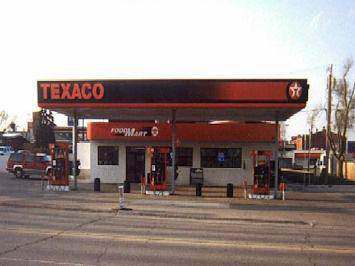
Under the conditions defined in the regulations, the use of combustible materials such as wood, polystyrene foam, mineral wool, linoleum and many others is permitted in construction. The restrictions are strong. For example, in Russia it is forbidden to build timber individual houses of more than two storeys (this also applies to Canadian houses), and semi-detached houses must be separated by a fire wall, and so on. In America the laws are simpler. There, unlike in Russia, building multi-storey buildings from SIP is not prohibited. There they have been used to SIP technology for decades, to the point that even petrol stations are assembled from SIP panels (photo from the SIPA website):
All talk about the fire hazard of materials and technologies outside the framework of the technical regulations is idle chatter by amateurs. Any building material is a fire hazard if it is used in violation of the current technical regulations! At the “Khromaya Loshad” there were unthinkable violations. Polystyrene foam on the ceiling was just one of the gross violations of the technical regulations. It was not the polystyrene foam that was ignited by the fireworks, but the combustible ceiling beneath it. Besides the suspended ceiling, the plastic wall finish also burned. But the main cause of the tragedy is that the people in that basement had no chance of survival if a fire broke out: the windows had been bricked up, leaving visitors not even an exit but a deliberately narrowed passage to the outside. Read the eyewitness accounts of the tragedy.
This has happened before. The terrible fire in 2006 at Moscow hospital No. 17 claimed the lives of 46 people who had been locked on the floor behind metal bars and doors. Then, too, they rushed to declare the wall finishing material the culprit of the tragedy and for a long time debated whether it was all an accident or arson.
The tragedy in Perm triggered a wave of pseudo-scientific disputes about whether it is acceptable to use combustible polystyrene foam to insulate the facades of multi-storey buildings. This has nothing to do with building individual houses! The requirements of the technical regulations are not comparable here. Strictly speaking, household gas should also be banned in apartment buildings: it is poisonous and explosive. And every stairwell has its own alcoholic.
With technically competent use, PSB-S is safe for insulating multi-storey buildings. For example, the “wet facade” system of polystyrene foam insulation (plaster over insulation) is classified as fire hazard class K0, the highest level of fire safety! Any material is dangerous if used incorrectly.
For individual (low-rise) construction, modern polystyrene foams are safe from the fire-hazard point of view. The conformity of polystyrene foam with the requirements of the technical regulations, like that of any other building material, is always confirmed by a certificate.
Rodents
By and large, this is a conversation about nothing. Rodents do not settle in SIP panels. This is a fact confirmed by decades of use of SIP houses not only as dwellings but also as warehouses, shops and so on. A huge amount of experience has been accumulated. Hundreds of thousands of SIP houses have been built in the USA and Canada. SIP has been used for building in Russia for ten years, and the number of houses built now runs into the thousands.
Polystyrene foam is inedible for mice. This is a scientific fact. Rodents do not build nests inside SIP. Practice proves it. So the danger of rodents for SIP turns out to be far-fetched.
Foreign literature and the internet mention the danger of termites. The problem is solved with special additives in OSB. In Russia this is not relevant.
There are reports of grey squirrels showing interest in SIP roof overhangs in one area of the USA. But the problem of mice and SIP is a topic of the Russian internet. The question of rodents constantly comes up on building forums. And these talks about the danger of rodents for SIP panels will probably never stop, because these little animals breed anywhere and gnaw everything. There are known cases where mice gnawed through concrete in search of food.
The main point: the problem of “SIP and rodents” does not exist! There is the problem of “rodents and insulation”. It is precisely the insulation that rodents can damage if they have access to it, breaking the thermal insulation of the house. It does not matter what walls or floors are being insulated, brick, timber or frame, or what insulation is used. All modern effective insulation materials will not withstand rodents’ teeth without proper protective measures.
But even the fiercest critics of insulation materials do not focus on this problem. And foreign manufacturers of polystyrene foam always stress how unattractive PSB is to rodents. The point is that the rodent problem is removed quite simply: rodents’ access to the insulation is closed off or made difficult. These are the so-called structural protection methods. And, of course, prevention is necessary. Without prevention mice will get into any house, even on the upper floors of concrete high-rises.
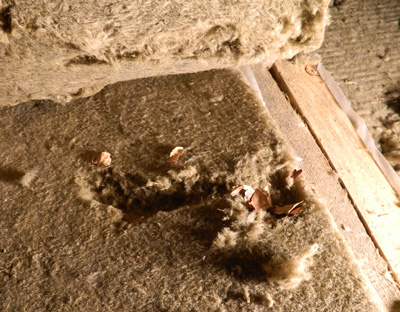
When discussing the rodent problem, remember that rodents prefer to use soft fibrous insulation, including stone wool and glass wool, as nesting material. Below is a photo of a vole burrow in the mineral wool of the attic floor of the second storey of a country house:
Polystyrene foam is inedible for rodents, that is, it has no nutritional value for them. So the polystyrene foam inside SIP does not attract rodents. Mice do not make nests in polystyrene foam, but they can make tunnels in it. So polystyrene foam, like any insulation, needs to be protected.
In SIP structures the polystyrene foam is tightly enclosed by boards and OSB panels. It is hard to explain why mice in natural conditions do not gnaw OSB-3, but it is a fact. One version is that the special structure of OSB-3 creates an insurmountable barrier for rodents. Indeed, the chips impregnated with binder in OSB are hard and brittle as glass. Trying to work with OSB without gloves immediately injures the skin of the hands. In addition, it is believed that the chips lying in different directions in OSB-3 get in the rodents’ way.
In principle, the structural protection of the insulation in SIP panels against rodents can be strengthened by placing a metal mesh or the like under the exterior wall finish. But nobody does this because there is no need. It is more rational to deal with such unlikely problems if and when they occur. And there are no such cases.
In practice we have never so far encountered rodent damage to SIP panels. So we do not recommend or use any special rodent protection measures.
In any private house it is advisable to have a biological weapon, a cat, or a psychological weapon, an ultrasonic rodent repeller, and so on. Structural methods are, as usual, grilles on the ventilation openings in the plinth. Rodents’ access under a ventilated facade can be closed off, for example, with metal mesh.
Rodents, like fires, are not a problem of the material of the enclosing structures of an individual house. It is first of all a matter of prevention. If you are irresponsible, even stone walls will not help. Using effective insulation and wood implies heightened attention to fire safety and hygiene, which is actually a good thing.
Ecology
Nothing is perfect. So much negative has been written about every building material on the Russian internet that it seems there is nothing left to build from. Hundreds of people are involved in finding, fabricating and spreading compromising material about competing materials and technologies. This puts the consumer in a rather difficult position. Separating information from rubbish takes a huge amount of time.
All building materials and technologies are good in their own way. And all materials have drawbacks, even ceramic brick. How many people have their mood spoiled by constant efflorescence on expensive facing brick? And salt corrosion, flaking and crumbling of building brick? And that is in the first years of use!
Attempts to compare different materials lead to huge tables of pros and cons. But the actual choice of technology and materials is not determined by objective reasons alone. Personal preferences matter enormously.
Advertising and anti-advertising are meant to influence our preferences. Arguments on forums and elsewhere are a powerful and very effective tool of anti-advertising. An argument on the internet is a gripping thing. Lots of emotion, you can write any nonsense, call names and so on. Well-thought-out argumentation can bring the audience round to the point of view needed for the cause.
Health and construction are not philosophy. An argument here does not give birth to truth. Here everything is concrete and is studied by scientific methods. There are laws, GOST standards, building and sanitary norms and rules, hygiene standards. There are international lists of environmentally safe building materials. Abroad, huge databases of scientific data on the ecology of all building materials and the chemicals they contain have been collected and systematised. Access to this information is open. For example, the US Department of Health’s dossier on styrene (November 2010) contains 283 pages. Such dossiers have also been created in Europe. And there are also worldwide organisations and so on. Meanwhile, on the Russian internet people argue by citing books and reference works from the 50s and 70s, which devote literally a few lines to these problems.
Here we will briefly run through the ecological “scare stories” from the Russian internet and the media that relate to SIP.
OSB-3
Just two years ago people were frightened mostly only by OSB-3 boards. It is precisely this material that determines the ecology of SIP, since it sits on the outside of the panel and isolates very well from the environment what is inside it.
For Russia, OSB is still a new and little-known material. In developed countries OSB has been used in housing construction for 30 years. And this material was developed specifically for housing construction! In America, residential buildings, offices, hospitals, sports and health facilities, and educational and children’s institutions are built from SIP. Americans, who have been building houses from SIP with OSB sheathing for more than 30 years, have no complaints about the ecology of SIP! The ecological “problem” of SIP arose on the Russian internet and was made up out of thin air by pseudo-specialist theorists with unhealthy imaginations and no knowledge of English, the language in which scientists all over the world exchange information.
For many people OSB is associated with Soviet-era chipboard with its phenols and formaldehydes. Time does not stand still. Health-safe chipboard meeting formaldehyde emission class E1 has long been made. And the OSB-3 production technology involves using an order of magnitude less binder than in chipboard production. OSB-3 is not recycled production waste. It is a product like glulam or plywood, that is, “improved wood”.
The first thing to remember when discussing ecology: SIP technology came to Russia from the civilised world, not from third-world countries. There is no counterfeit OSB-3 on the market. OSB-3 boards are still not produced in Russia (it is a very capital-intensive production, ~100 million euros). All products come to the Russian market from Europe and North America, which have the strictest requirements in the world for the environmental safety of building materials used in housing construction. A few quotes:
- The use of resins consisting of the resin itself, a filler and a hardener makes it possible to produce an environmentally safe building board, since the polymerisation process is finally completed a few months after pressing, and after that time formaldehyde emission cannot be detected by existing measuring instruments (Egger, Germany).
- The amount of formaldehyde emitted by the OSB used in SIP is less than 0,1 ppm (parts per million). This is significantly below the level permitted by the US Department of Housing and Urban Development (HUD) (Structural Insulated Panel Association, SIPA).
Americans and Europeans are very particular about the environmental cleanliness of everything around them. Picky and demanding American and European consumers took the problem of ecology seriously before Russians had even heard the word “ecology”.
In Europe, materials are divided into three classes by the level of formaldehyde emitted: E1 (up to 0,1 ppm), E2 (0,1...1,0 ppm) and E3 (1,0...2,3 ppm). Russia has a similar classification, only with higher emission levels in the classes. Formaldehyde is found in many natural objects, including wood, the benchmark of environmental friendliness. It is wrong to say that some materials emit formaldehyde and others do not. Almost all emit it, even wood. It is just that some materials in principle cannot emit formaldehyde in large amounts. Then the class is either not assigned at all or E1 is assigned without testing. And there are materials that have to prove their safety. E1 is the highest safety class. OSB boards meeting emission level E1 emit as much free formaldehyde as solid wood, or slightly more. In particular, the German company EGGER makes OSB boards with a formaldehyde emission level below 0,03 ppm. They contain the same amount of formaldehyde as natural wood! For advertising purposes such materials are often labelled E0. In fact this is class E1 (class E0 is not standardised).
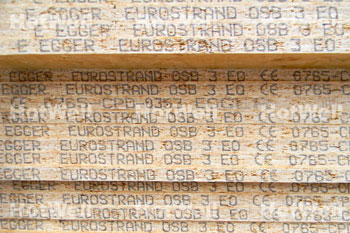
We use OSB-3 “EGGER” E0 made in Germany to produce SIP panels intended for building residential houses. Germans are Germans. Their boards even smell of wood! Incidentally, it was the German concern BASF that produced the world’s first foam plastic in 1951. Since then the Germans have been world leaders in the production, practical application and scientific research of this insulation.
Compliance of building materials with European class E1 (the Russian one is less strict) makes any fears about harm to health groundless. Class E1 materials are intended for residential rooms, for making children’s furniture and so on. Such a familiar material as plywood often meets Russian class E2.
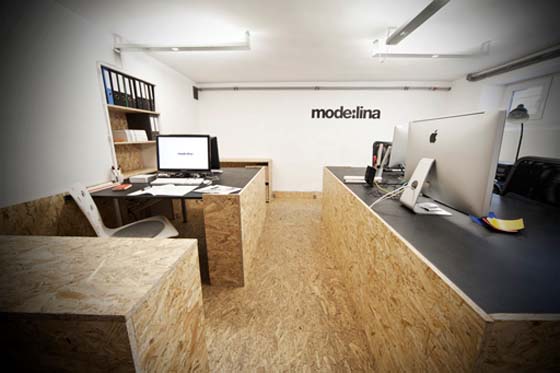
When caring about health, more attention should be paid to finishing materials (paints, wallpaper, MDF, floor coverings and the like). Even individual pieces of furniture can pose a greater health threat than the entire structure of a Canadian house.
One of the main ideologists of the criticism of OSB-3 and other materials used in frame construction, a member of the RAEN society (not to be confused with the Russian Academy of Sciences, RAN), states:
“At the beginning of the 90s, those Western European countries where much attention is paid to protecting public health (Germany, Finland, Sweden) banned the use of materials that emit formaldehyde in housing construction. The use of OSB boards was also banned.”
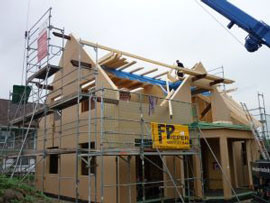
Anyone can check that this is a lie. Germans do use OSB in housing construction, and not only as a structural material but also for interior finishing of rooms. The paradox is that Germany is the largest consumer of OSB in Europe (15,8% of the Europe-wide volume). Below are a few photos from the German internet with links to the source. A house made of OSB-3 before and after finishing:
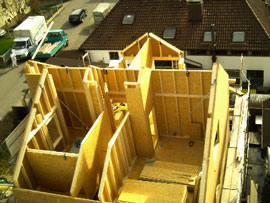
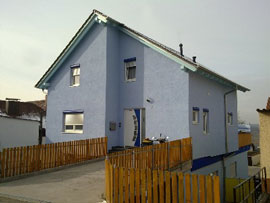
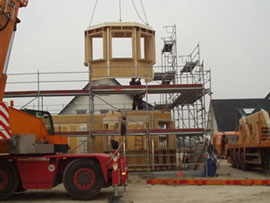
To finish frame houses in Germany, EPS polystyrene foam (PSB) is often used and then plastered (the “wet facade” system). So it is practically impossible to tell from the outward appearance that a house was built with frame technology. Germany is the main consumer of polystyrene foam in Europe (48%). France is in second place. A few more photos of residential construction from OSB-3 in Germany, with links to the source:
And here is a quote about the construction of a hotel at a world-famous Alpine ski resort in Tyrol (Austria):
“In total about 2000 sq. metres of OSB boards by EGGER were used to build the 4-star Arlmont hotel, opened in June 2009. Their unmistakable surface structure was left exposed and used as a decorative element in ceiling cladding, and also where the boards served as concrete formwork. In addition, the design planned for OSB boards to be used in interior finishing as sound-absorbing products as well.
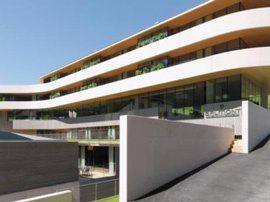
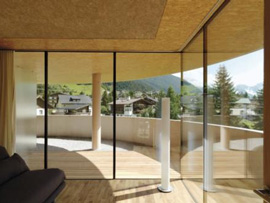
According to the hotel owner, Mr Stemberger, the decision to use OSB boards for construction came immediately: ‘We were sure of our choice of OSB boards from the start. The boards bring a special mood to the hotel’s interior, which is very valuable to us and creates a cosy atmosphere for guests. For the architects, too, there was no question of choosing a different material. OSB boards fit the overall style of the hotel perfectly. Like all the other materials used to build the hotel, the OSB boards are left exposed and unclad so that the wood structure of the surface is visible,’ explains Mr Bleser, a representative of Tatanka Ideenvertriebs GmbH.”
Europeans do not read the articles of the scandalous “academician” from Russia, which is why they build 4-star “gas chambers” for tourists in mountain resorts. It seems our “academician” is not on friendly terms with foreign languages either, if he writes or signs such nonsense.
EPS (PSB) polystyrene foam
styrene → polystyrene → polystyrene foam.
Styrene is a substance found in many natural objects. Even the ancient Egyptians used the resin of the oriental sweetgum tree (Liquidambar orientalis) as an aromatic substance in perfumery and medicines. The aromatic resin, which is still collected and used in medicine as an antiseptic, for inhalations, and also in perfumery and soap-making, forms from the tree’s fluid secretions at the site of damage to its bark and is called storax. It is styrene that gives the resin its smell. That is why the German pharmacist Eduard Simon, who in 1839 isolated the pure substance as a liquid from storax and found that after a few days the styrene had thickened, gave it that name. This is how the styrene polymer, polystyrene, was discovered.
Humans have long used natural polymer materials in their lives. These are leather, fur, wool, silk, cotton, natural rubber and much more. Life on Earth arose and exists thanks to natural polymers.
In the 20th century people learned to synthesise styrene on an industrial scale. Since then polystyrene has firmly entered our lives: disposable tableware, food trays, yoghurt packaging, the plastic lining of a household refrigerator’s chamber in which food is stored, children’s toys, radio and TV housings, light fittings and much more.
Polystyrene is a harmless substance, but under certain conditions it can release styrene. Styrene is recognised as a weakly toxic substance. In large concentrations styrene causes irritation of the mucous membranes of the upper respiratory tract, headache, and disorders of the central and autonomic nervous systems. We read GOST 10003-90 “Styrene. Specifications.”:

Moderately hazardous substances include, for example, ethyl alcohol, aluminium and iron. The lethal doses LD50 established on rats are of the same order for styrene and ethyl alcohol (5 and 9 g/kg respectively).
A study of the scientific information on styrene can begin with the website of the American research centre SIRC, which has been studying the effect of styrene on human health and on the environment for 25 years.
Since 2007, the use of chemicals in EU countries has been regulated by the REACH regulation (the European Community Regulation on the Registration, Evaluation, Authorisation and Restriction of Chemicals). Under REACH, a technical dossier on styrene was created in 2. As a result of studying and systematising all the research data on styrene currently available, the following classification and labelling were adopted: styrene is not a mutagenic or carcinogenic substance and does not affect the reproductive function of the body.
The question of styrene toxicity is a question of the concentration that is dangerous to health. In large doses everything is harmful. We eat some products that contain styrene: strawberries, nuts, kiwi, grapes and so on.
Russian hygiene standards (GN 2.1.6.1338-03) define the maximum permissible concentration (MPC) in air for about seven hundred substances. For styrene, a maximum single MPC of 0,04 mg/m3 and an average daily MPC (MPCad) of 0,002 mg/m3 have been set.
The lowest concentration at which a negative effect of styrene on humans has been noted is 84 mg/m3. That is 2000 times the maximum single MPC and 42000 times the average daily MPC for ambient air!
The MPC (TLV) for the working area is set at 85 mg/m3 in the USA and at 10-30 mg/m3 in Russia (GN 2.2.5.1313-03). According to American data, a styrene concentration of 34 mg/m3 is the NOAEL (no observed adverse effect level), at which no harmful effect of styrene on humans is observed.
The official RfC level (reference concentration, chosen on the basis of in-depth analysis of international and foreign safe-exposure levels) for styrene is 1 mg/m3. That is 500 times higher than the Russian average daily MPC for ambient air.
The nonsense about styrene accumulating in the human body is spread on the Russian internet by critics of polystyrene foam, citing one another in a closed circle. This is rubbish. The so-called “cumulative properties” of styrene are not confirmed by scientific research! A survey of workers in the USA working 8 hours at a styrene concentration of 160 mg/m3, which is 80 thousand!!! Russian MPCad, revealed no accumulation of styrene in the body. It is easy to calculate that under the so-called linear concept, 8 hours at this concentration corresponds to 73 years of life at the MPCad. And our “theorists”, on the assumption that the “linear concept” applies to styrene, propose reducing the MPCad by a factor of 600 and banning polystyrene foam on that basis! It is known that if a “concept” does not describe experimental data, then the concept itself and the conclusions drawn from it are pseudoscience. For a member of the RAEN society that is forgivable (there are many such people there).
RAEN is a typical imitation brand, just like Abibas, Malboro, Naik, Levins, Rebok and many others. To make the imitation complete, members of RAEN, like full members of the Russian Academy of Sciences (RAN), call themselves academicians. Some members of RAEN use this imitation brand for its intended purpose: making a profit. Our critic of polystyrene foam diligently pushes his miracle primers onto the market. Another scandalous RAEN “academician” earned a good income before his trial from selling immortality.
Another lie that all opponents of polystyrene foam repeat like parrots:
“Styrene has a strong effect on the liver, causing, among other things, toxic hepatitis.”
Some critics have got so carried away that they now call styrene nothing less than a “liver poison”!
Scientists have not been able to detect an effect of styrene on the human liver even at industrial concentrations. Even higher concentrations were tested on animals. Experiments on mice exposed to 160 ppm of styrene for 2 years revealed no changes in the liver (no liver effects were observed at 160 ppm after 2 years of exposure). And 160 ppm of styrene is an enormous concentration. It is 340 thousand Russian MPCad. At this concentration a person can barely tolerate the smell of styrene even for a short time. Those who scare people with the effect of styrene on the liver have in mind concentrations millions of times lower. By the “linear concept” of styrene accumulation in the body, 2 years at 160 ppm equals 680 thousand years at the MPCad. To destroy the liver, a person has to drink styrene, not sniff it.
PSB (EPS) polystyrene foam is expanded polystyrene. It is precisely suspension-type pressless polystyrene foam (PSB) that is commonly called foam plastic.
Today PSB is considered the best insulation. It is the most sought-after insulation in developed countries, and not only because of its low price but because of its combination of properties, including service life and environmental friendliness.
In Japan houses have begun to be built from polystyrene foam, and it is already called a structural material of the 21st century (i-domehouse.com):
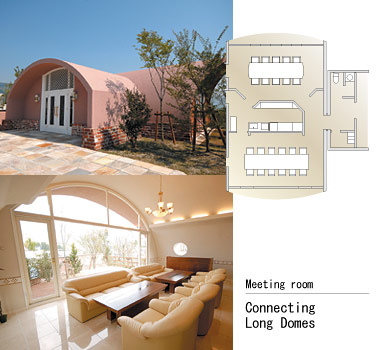
The paradox is that the Japanese offer such houses for health recovery (for Health Recuperation)! This simply does not fit with the opinion of our obsessed “academician”, who considers such houses “gas chambers”.
PSB is not a perfect material. The main drawback of polystyrene foam is flammability, which places restrictions on its use in construction. Flame retardants together with structural protection solve the flammability problem of polystyrene foam by 100%.
PSB is air. There is less than 2% polystyrene by volume in the PSB-25 used to make SIP.
Modern PSB contains very little residual styrene and therefore does not emit it in amounts dangerous to humans. And depolymerisation of polystyrene foam is possible only at a temperature well above 100-110ºC. This is a scientific fact. The tall tales of constantly emitted styrene are spread by deliberately interested people who have never done scientific research on polystyrene foam.
There is no data on how much styrene can pass through the sheathing of a SIP panel. But OSB-3 12 mm thick blocks the diffusion of water vapour like a vapour barrier (Sd 2 m according to DIN 52615), and a water molecule is much smaller than a styrene molecule.
When studying various opinions about building materials, remember that where there is vested interest, it is hard to count on objectivity. The Russian internet and media contain a great deal of disinformation and distortion of facts, both from critics and from their opponents. In this situation the only way out is to study the question carefully and work everything out for yourself! There is enough information on the internet. Any person with a critical turn of mind can always tell where the facts are and where the guesswork is, or where one problem has been swapped for another.
One professor, who makes money on “nanoconcrete” and foam glass, announces from the TV screen that when heated without access to air, polystyrene foam releases phosgene because of the flame-retardant additive, and that this caused the mass deaths at the “Khromaya Loshad”. Then another “academician”, already mentioned above in connection with OSB, corrects him in his article: firstly, phosgene formation requires chlorine, and flame retardants contain bromine, not chlorine; and secondly, phosgene cannot be the cause of death in a fire, because the poisoning effect of phosgene appears only after several hours, during which the person feels perfectly fine! It is easy to check that this is indeed so. Phosgene from PSB polystyrene foam is an ordinary journalistic “canard”.
Here you can see the results of state tests (March 2010) of polystyrene foam under heating. The modern instruments of the Mendeleev Institute of Metrology (VNIIM) detected no release of phosgene from the polystyrene foam of the “NovoPlast” plant (used to make SIPwall SIP panels).
“I am not a specialist,” said one of the main ideologists of the campaign against polystyrene foam, the director of a company doing PUR foam insulation of houses, at a round table on 4 February 2011 at the Russian Academy of Architecture and Construction Sciences (RAASN), to thunderous applause from the audience. About “his” technology he writes simply and clearly:
“The polyurethane foams used by the company are environmentally safe in use. There are corresponding permits for the use of polyurethane foam from the sanitary and epidemiological authorities.” (“Polyurethane Technologies”, No. 4 (7)/2006)
Polyurethane foam (PUR) is a good material, but it has more environmental problems than PSB. PUR is made from poisonous components, and when PUR burns it releases hydrogen cyanide, which according to statistics is one of the main causes of death in fires.
A few words on how critics of polystyrene foam fool readers, just as their opponents do, playing with numbers and words. Above we pointed out that the ignition temperature of polystyrene foam is almost twice that of wood, and that modern self-extinguishing PSB burns on its own for no more than 1 seconds. That is good, but of no great importance. If something burns next to polystyrene foam, even self-extinguishing, it melts, and the melt burns, at a higher temperature and with more heat release than wood. That is already bad. But in any house there is an order of magnitude less polystyrene by mass than other combustible materials, including wood, so its share in heat generation is only a few percent. The result is not bad.
Now remove the sentence about the high burning temperature of polystyrene from the previous paragraph. You get a fire-safe material. If you do the opposite and leave only the information on the high burning temperature and high heat release, the conclusion is different. And if you add the information that polystyrene is used as a thickener in one type of napalm, the conclusion is decidedly negative. In reality polystyrene is not only a thickener in napalm “B” but also a retarder of the combustion of the other components of the napalm. The basis of black powder is charcoal, but that casts no shadow on wood. A good chemist can make a bomb out of sugar in a minute.
“I collected information bit by bit in countless discussions on the internet. I put up still-raw fragments for public flogging. And I was flogged. So much so that I had to redo everything from scratch. I make no claim to truth, and I am certainly in many matters either mistaken, or poorly informed, or the time for Truth has not yet come at all.”
That is how the author of the Wikipedia article on polystyrene foam, a specialist in foam concrete (!) from Kharkiv, writes about himself. And they are right to “flog” him. Information should be gathered from scientific works, not from forums. Like everyone who makes money on foam concrete, the author “fiercely hates” the main competitors, the producers and sellers of permanent polystyrene foam formwork. It just so happened that these two building technologies squeezed into one market segment.
The Wikipedia article on polystyrene foam is a serious piece of work. It has 171 references to authoritative sources (as of 3 January 2011)! If you put together all the Wikipedia articles on foam concrete, the text would be shorter than the list of sources in the article on polystyrene foam. At last someone had decided to dot all the i’s in a protracted public discussion! Not so fast. You read the sources and start to understand why the scientific status of the Russian-language Wikipedia is questioned. What is good for forums is not suitable for Wikipedia. This is not a scientific article but merely a reflection of the public discussion on the Russian internet, and from the position of one of the sides at that. Yet quotes from this article instantly multiply across the Russian internet together with all the “inaccuracies” that the author corrects after being “flogged in public”.
We compare what the sources say with what the article says. For example, the smoke-generation coefficient of PSB-S polystyrene foam is 749 m2/kg, while the article gives 1219 m2/kg for polystyrene foam. You look at the reference and it turns out to be the smoke-generation coefficient of PS-1. This is so-called “rigid foam plastic”. Its density is dozens of times that of PSB. A very expensive material. Depending on the density of PS-1, a m3 will cost tens and even hundreds of thousands of roubles. Houses are not insulated with this material. PS-1 is used in shipbuilding and in the radio and electrical industries.
The article says that the smoke-generation coefficient of polystyrene foam is 53 times higher than that of wood. As we have found out, PS-1 was taken for comparison, not PSB. So it is no longer 53 but 33 times. The source cited in the article shows that the comparison used the figure for wood burning in the open with excess oxygen: 23 m2/kg. When wood smoulders, the smoke-generation coefficient is 345 m2/kg! That is only 2 times less than for PSB. The same sources show that the maximum smoke concentration in a fire of timber structures is already reached in the second minute. Because oxygen burns out quickly, the wood begins to smoulder. And the smoke-generating ability of polystyrene, on the contrary, decreases when oxygen is short!
Now divide everything that concerns polystyrene foam by 30, because a m3 of PSB-S25 is 30 times lighter than a m3 of dry wood, and smoke generation is determined relative to mass. So much for 53 times! The fact that polystyrene is denser than water does not mean that polystyrene foam will sink.
You read in the article about the complex fire-hazard index of plastics, but in the original monograph the author cites there is no such index for polystyrene foam. The author did not exactly lie, but everyone thought specifically of the high fire hazard of polystyrene foam. And the article is not about plastics in general but specifically “about polystyrene foam”.
You read in the article about the “serious concern” of UN experts over the use of the flame retardant HBCD, but the UN document the author cites says directly that HBCD enters the human body not from insulation panels but with food, that the harmfulness of HBCD to human health requires study, that the proposal to classify HBCD as a toxic substance within the EU is still only under discussion, and so on.
The facts are presented tendentiously. The information that burning 70 grams of polystyrene foam makes a m3 of air unfit for breathing is calculated purely for emotional effect. 70 g of PSB-25S is a piece with a volume of almost 5 litres, not a matchbox as it may seem at first glance! To burn a piece of dry wood of the same volume, you would need all the oxygen from 10 m3 of air! And how much air would become “unfit for breathing”?
Another example. The author compares the self-ignition temperature of polystyrene foam, which is almost twice that of wood, with the self-ignition temperature of petrol (200-410°C). Everyone knows it is not petrol that ignites easily but its vapours. Petrol has a low so-called flash point. You can put out matches and cigarette butts in petrol. That is a well-known trick.
Note: in the version of the Wikipedia article on polystyrene foam of 17 February 2011, some of the “inaccuracies” noted above have already been corrected by the author. Opinions of scientific experts have been added to its text. Overall the tone of the article has changed substantially. And in the version of 14 June 2011 little is left of the original article. But, as mentioned above, the rubbish from the early versions of the article has spread widely across the Russian internet.
Such manipulations of numbers and words form the basis of absolutely all critical articles about polystyrene foam. Usually a little spice is added to this soup of half-truths: outright lies and gossip. This concerns the effect of styrene on human reproductive function and the “fairy tale” about the cabins on the BAM railway. In the West, tens of thousands (!) of pregnant women workers and wives of workers employed in production with high styrene exposure have been examined, and no effect on the frequency of spontaneous abortions or congenital malformations was found. And we are talking about styrene concentrations for the working area that exceed the MPCad by tens of thousands of times!
The situation is similar with the service life of polystyrene foam. A term of 10-15 years is disinformation. Scientific data (accelerated tests) give at least 80 years. Western full-scale tests over decades (BASF) found no visible change in the state of polystyrene foam and no decline in its technical characteristics over time. Because of this resistance to ageing, polystyrene is a headache for environmentalists. It does not rot and does not decompose in landfills, thereby polluting the environment. Polystyrene foam requires special disposal, and this is a serious drawback of the material.
Note that the lies about polystyrene foam are aimed at “scaring housewives”. Anyone who starts to look into it discovers the deception right away. You visit the website of “Giprolesprom”, the source of the notorious articles about OSB-3 and polystyrene foam that went around the Russian internet, and instead of the state design institute “Giprolesprom” you see a firm of paving-slab layers with mobile phone numbers and an expired building licence. A typical trick that relies on inattention. A grand name or title always inspires trust in the consumer. A normal person will never believe articles from a “pseudo-institute”. Few know that the author of the “Giprolesprom” articles also considers metal roof tiles harmful to health, because they “shield the building from the Earth’s magnetic field and cosmic radiation”! He offers his own development: painted asbestos slate. “Nanowood” (wood impregnated with a phosphorus-nitrogen flame retardant) is also “Giprolesprom”.
The “exposé” articles on polystyrene foam or OSB from “Giprolesprom” usually end with insistent advice to buy their “detoxifying” primers, which completely solve the problems of phenols and styrene! A quote:
“To sharply reduce or completely prevent the emission of formaldehyde from OSB boards and styrene from polystyrene foam, all interior surfaces in the house must be treated without exception: the first primer – ........ (250 g/m2), which irreversibly absorbs formaldehyde and partly styrene, the second primer – ........, which completely absorbs styrene. In addition, the simultaneous use of these primers provides fire-protection category 1 for OSB boards.”
Such marketing smells of crime. In medicine, placebos are prescribed to patients prone to autosuggestion. In this case the author first frightens the client into panic and then offers to buy a saving “miracle pill” of his own production. Be careful! That his chemicals are harmless is known only from his own words.
You do not need to buy anything. Studying scientific sources destroys all fears for good. On the Russian internet there is little information and a lot of rumour. Abroad, by contrast, any problem gives rise not to talk or rumours but to large-scale research. The information is open. Translating from English into Russian is not a problem. Online translators will help those who “studied German at school”.
A remarkable fact: one of the authors of the “devastating” articles about polystyrene foam awarded himself the academic degree of Doctor of Technical Sciences! Of course this has no direct bearing on the content of the articles, but the craving for publicity, for fake titles and for grand names like “nano...” says a lot.
Around polystyrene foam there is now not science but commerce and politics. The position of the critics of polystyrene foam rests largely on the opinions of journalists, politicians, officials and other people who are sometimes far from the problem and sometimes have a vested interest. That is already completely unscientific.
When interested parties start caring about others, oddities arise. “The new requirements introduced in SNiP II-3-79 ‘Building Thermal Engineering’ find no understanding or support among designers, builders and specialists in the building materials industry.” This is a quote from an article published in the newspaper “Stroitelny Expert”, No. 10(101), 2001, two years before the new SNiP 23-02-2003 requirements for the thermal protection of buildings came into force. It was signed by respected people – honorary builders and directors of brick plants. And they are rightly concerned about the durability of houses, their architectural appearance and the fate of the domestic construction sector. But it is clear to anyone that builders got an extra headache, while brick was pushed out of the market by materials with better thermal resistance (foam concrete, insulation and others). Anyone in their place would “not understand or support” it. Asking producers and sellers of mineral wool, PUR foam or foam concrete about the ecology of expanded polystyrene is like asking flower sellers whether Russia needs Valentine’s Day. Try asking an EPS manufacturer whether mineral wool can be used to insulate housing.
You may come across claims that expanded polystyrene is banned in residential construction in developed countries. This is disinformation. In developed countries, expanded polystyrene (EPS) is considered one of the most environmentally friendly materials used in construction. EPS has the highest ecological rating (details). Eight out of ten single-family houses in Europe are insulated with EPS (promo-pse.com)! In Germany, expanded polystyrene is consistently the preferred material for building insulation, covering 87 % of all thermal insulation needs of this developed European country (mineral wool is used in only 12 % of cases). At the same time, the share of expanded polystyrene among other insulation materials worldwide keeps growing, which of course alarms the producers of mineral wool and other insulation materials.
The deeper you look into the problem, the more you become convinced that, when used correctly, PSB polystyrene foam is a material that is safe for health. This has to be proven continuously, and it is the manufacturers and their associations who must do it. That is the practice in the civilized world, enshrined in law. Manufacturers spend years and millions of euros registering their products under the European REACH regulation. The tragedy at the “Lame Horse” club forced Russian polystyrene manufacturers to stir as well. The round table held on 4 February 2011 at the RAACS was probably the first attempt to involve scientists in the long-running public debate. But “the victory of common sense” that the organizers were quick to announce is as far off as the moon. There are results, though. For example, the Wikipedia article on expanded polystyrene has changed.
Note that mineral wool insulation is also accused of being environmentally unfriendly because of binders based on phenol-formaldehyde resins. In the ranking of one of NTV’s “yellow press” programs, mineral wool was awarded an honorable third place among all (!) building materials in terms of danger (after foam concrete). This is, of course, complete nonsense, but every builder knows what happens to the skin and lungs after a few minutes of working with mineral wool without a respirator. “Attacks” on mineral wool should also be treated critically. Mineral wool should simply be used correctly. For example, if mineral wool insulates a house facade, the insulation is covered with a wind barrier, and no mineral wool dust gets into the air.
Mineral wool is practically non-combustible. It has good sound absorption. Thanks to these advantages, mineral wool is widely used in housing construction. Mineral wool boards are the main insulation in frame structures. Expanded polystyrene is poorly suited for this: it is hard to cut and fit into an ordinary frame. A special frame for polystyrene is made of metal, which is not great because of the thermal bridges it creates.
To sum up, the ecology of expanded polystyrene is not a problem of SIP technology. In SIP panels, PSB polystyrene foam is covered by OSB-3 boards, which let nothing through and also protect the polystyrene from open flame. For SIP it would be more correct to use PSB without flame retardants at all, but it is not officially produced.
Our SIP panels, as a building material, meet the highest environmental requirements. This is ensured by the high environmental friendliness of the components we use to manufacture SIP.
Price
Unfortunately, SIP panels, like all other building materials, are not cheap. An OSB-3 board is no less expensive than premium glued laminated timber. The factory wholesale price of 25-grade polystyrene foam boards of the size required for making SIP has long exceeded 2 thousand rubles per m3. In addition, the cost of SIP includes glue and the manufacturing fee. The latter worries many people, and ways to avoid it are often considered.
Making SIP panels yourself is possible in principle. But they will be handmade panels. Handmade panels do not necessarily have to be glued by yourself. They can be bought cheaply on the Internet. There is no guarantee that your panels will turn out better and cheaper than purchased ones. Besides, when buying, you still have a chance of getting your money back. There are known cases where people managed to get a refund for substandard panels.
If buying SIP is too burdensome for your budget, it is better to look at classic frame technology. It is more reliable than experiments with your own production or buying cheap handmade products.
SIP technology is not the cheapest. If you build an energy-efficient house yourself using classic frame technology, you can get the result at lower cost than building from SIP. American specialists believe that the higher price of SIP houses compared with some frame houses pays off over time through better performance. Of course, walls of the same thickness are being compared. There are, of course, frame houses that are much more expensive than SIP houses.
Mineral insulation is usually used to insulate walls with a wooden frame. For frame walls to be as warm as SIP walls 174 mm thick, you would have to build the frame from studs 200-250 mm wide instead of the usual 100-150 mm, and insulate it with a 200-250 mm layer of mineral wool. So frame walls equivalent in energy saving turn out to be no cheaper than SIP walls even in terms of materials. In addition, using SIP for walls significantly reduces construction and assembly work and improves strength and other characteristics compared with frame walls.
If frame technology can compete with SIP on price, other “budget” technologies can no longer do so. At first glance, walls of 150x150 mm sawn timber and 174 mm SIP cost roughly the same in materials. The drawbacks of timber walls are well known. It takes years to get wooden walls ready for use. That is why sawn timber is now used less and less, in favor of expensive profiled or glued timber. But that is not the only problem. Even well-built timber walls 150 mm thick are very cold for the Moscow region and have to be insulated. The price grows and new problems appear.
Strength
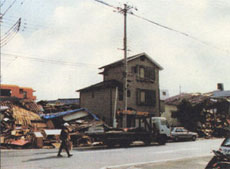 We discussed the exceptional strength of the Canadian house above. One nuance: that was the strength of the Canadian house as a structure, and in that respect it has no equal. However, in wartime it is still better to defend yourself in a brick house: thick stone walls protect against bullets and shrapnel. True, a battle for your country-house community is unlikely, and gangster shootouts have died down. But in an earthquake or hurricane it is definitely better to be in a Canadian house. Many of those who lived through such a natural disaster later moved into safe Canadian houses. As, for example, in conservative Japan, after the earthquake of 1995 that claimed 5000 lives in Kobe, where all six Canadian houses withstood it (photo).
“– A piglet’s house must be a fortress! – Nuf-Nuf calmly replied, continuing to work” (S. V. Mikhalkov, “The Tale of the Three Little Pigs”, 1936). And the piglet’s means of transport must be a tank.
The requirement that walls resist break-ins or local mechanical destruction is not unconditional, even for structures such as a prison or a bank vault. Even in such cases it is better to invest in security systems. Neither stone walls nor window bars will protect your house from burglary. It is better to get a dog if the house is for permanent residence. People have long understood all this. Lately, video surveillance security systems can increasingly be seen on country houses (both stone and wooden). These systems are affordable and very effective.
You should not think that a SIP house is flimsy. Owing to its structural features, a SIP panel is extremely strong and cannot be punched through with a sledgehammer right away. So in terms of break-ins, a Canadian house is stronger than an ordinary frame house.
Sound insulation
Sound insulation is not as acute an issue for a detached country house as for an apartment building. The mere absence of noisy neighbors above or next door ensures a quiet and peaceful life. This is one of the main advantages of living in your own house.
There are two kinds of noise: airborne (music, human voices, etc.) and impact (knocking on structures). Like all similar layered “mass-spring-mass” structures, a SIP panel effectively insulates against airborne noise, especially at high frequencies. At low frequencies, light walls lose a little to massive ones.
That is in theory. In practice, noise from a TV or a conversation in the next room hardly penetrates a 174 mm SIP panel faced with plasterboard on both sides. The sound seems quieter than the ticking of a quartz clock and does not disturb sleep at all. Nor is there any discomfort in a SIP house from what happens outside. To hear a train passing nearby you have to listen on purpose, and it is practically impossible to shout to the owners from the street. This has been checked a thousand times. To get someone to respond, you have to knock on the wall. And that is already impact noise.
As for airborne noise, practically all structural materials have similar characteristics. An effective solution to the sound insulation problem is to use multilayer structures and special sound-insulating and sound-absorbing materials.
For reference: a heavy curtain reduces the noise level by 13 dB, and doubling the thickness of a brick partition reduces it by 6 dB. The weak point for airborne noise in any house is the windows and doors (exterior and interior).
As for impact noise, a SIP panel, due to its rigidity and low weight, loses to massive brick or concrete walls. But impact noise in a detached house is exclusively an issue of the intermediate floor. In a Canadian house only guests knock on the walls, after learning the house is built of SIP. It is in a multi-story concrete building that everyone suffers when somebody starts drilling a wall.
In any house, if necessary, the impact noise problem is solved by design measures. For example, “floating” floors are made. Carpeting and the like also effectively insulate against airborne and impact noise.
SIP intermediate floors are often used in detached houses. Experience with such houses shows that SIP floors cause no significant inconvenience. But most builders agree that massive beams are better than SIP for an intermediate floor. Again, though, in a detached house impact noise for floors is not a serious problem. As a rule, the second floor is a rest area, not a place for sports. If you cover the second-floor floor with carpet, footsteps will not bother you with any floor structure.
Ventilation
The need for good ventilation is for some reason considered a peculiarity (a drawback) of Canadian houses. People are confused by the comparison of SIP houses to a thermos. In reality, they share only the high thermal resistance of the walls. Unlike a thermos, a Canadian house has windows and doors through which fresh air is drawn in from outside constantly or periodically. Just as in any other house, laundry is dried, food is cooked, baths are taken and so on in a Canadian house. And none of this requires any special, sophisticated supply-and-exhaust ventilation system.
Let us begin with the fact that any living space must be well ventilated. According to SNiP 2.08.01-89, the air in a living space should be renewed roughly every hour. This includes a wooden house, since the ability of wooden walls to absorb moisture and carry the toxic products of human activity outside affects the air in a living space only slightly. The air permeability of wood is also of no significant importance. The positive effect of using wood, brick, foam concrete and other materials for walls is only a few percent at best.
The feeling of fresh air in wooden structures comes from the numerous gaps through which fresh air is constantly drawn in from outside (infiltration). In technical terms, the air permeability of a wooden structure is often several hundred times higher than that of the wood itself. How wooden walls “breathe” is best observed in winter with a thermal imager:
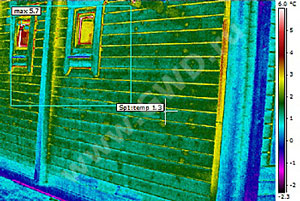
The yellow gaps on the thermogram of a timber wall are warm air escaping outside from the room (cold air is drawn in from below). If you drill a few through holes in a SIP wall, it will “breathe” no worse than a wooden one!
A little infiltration does no harm. But excessive air infiltration through the walls often becomes a very serious problem in wooden houses. You have to remove the finishing and caulk the gaps that have formed. We have already had several clients who chose SIP technology precisely after an unsuccessful experience with wooden houses.
The “problem” of ventilation is also faced when old “breathing” wooden windows are replaced with modern double-glazed units. The numerous gaps in old wooden frames provide a constant inflow of fresh air from outside. Whether this inflow is sufficient under hygiene standards depends on the condition of the window frames. This air exchange is regulated in a well-known way: in winter the gaps in wooden frames are stuffed with cotton wool and sealed with paper tape. In summer, on the contrary, the small top window is opened.
Modern windows are airtight. If they are kept closed all the time, ventilation is possible only through gaps in walls and doors. In a wooden house this is not critical – there are enough gaps in the walls too. In stone houses owners already have to remember regular airing, and manufacturers have to add various improvements to window design, such as slot (winter) ventilation.
Thus the “problem” of a Canadian house with airtight windows and doors is that a person controls the ventilation of the room, right up to (in theory) completely cutting off the air supply from outside. But this is not a drawback, it is an advantage! Being able to control air exchange in a Canadian house lets you optimize it in terms of heating savings. Rooms we use rarely are aired less often, and vice versa. Went into the study to work – open the window for a few minutes. Aired the bedroom before sleep, and so on. We were taught all this at school. The lazy can keep the windows permanently in slot-ventilation mode. The effect is the same as in a wooden house with its gaps.
In winter there is a temptation to minimize air exchange with the cold outdoors. Excessive saving on ventilation can cause problems with the air quality in the house!
The kitchen and bathrooms require more intensive air exchange. This is exactly where natural or forced extractors are placed. Fresh air enters through windows and gaps first into the living rooms, then into the utility rooms where the extractors are located. Naturally, the utility rooms get more intensive air exchange.
Many people link the ventilation problem to the low vapor permeability of SIP panels. In fact, low vapor permeability is an advantage of SIP. Moisture inside walls is always bad. Because the dew point in the cold season ends up inside the wall, vapor that gets into the wall does not escape but accumulates in it as condensate. The wall’s thermal resistance and service life decrease. Dampness causes fungus and mold. The indoor microclimate deteriorates.
“Breathing walls” is advertising. No SNiP permits using a building envelope to dry the air! The term “wall breathing” is not technical. The amount of water vapor passing through an exterior wall by diffusion does not affect the indoor microclimate. This is a scientific fact. The vapor permeability of brick is twice that of wood across the grain, so let us look at the “breathing” of brick walls. The flow of water vapor through brick walls makes up 0,5-3% of all water vapor removed from a home. Brick walls are unable, even partially, to replace ventilation in removing water vapor from rooms. According to scientific data, rooms in a Canadian house need to be aired at most 3% more often than in a brick house.
The question of arranging ventilation concerns many people. The answer is this. A modern forced ventilation system is not a mandatory attribute of a Canadian house! This is a fact proven in practice. Americans claim the opposite. But they have a different mentality. A ventilation system is as wonderful and useful a thing as, say, a built-in vacuum cleaner or climate control. It is convenient but not available to everyone. In Canada houses are no longer built without such systems. In our conditions it is quite possible to manage with the usual airing through a small window. An extractor must be installed in rooms with high humidity (kitchen, bathrooms). In other rooms, regular airing through windows is enough.
Thermal inertia
The low heat capacity of SIP panel walls, mentioned above as an advantage, can in some conditions also be a drawback. Massive, heat-retaining walls can act in summer as a passive temperature regulator indoors thanks to the daily temperature swing. Walls cooled overnight cool the hot air coming in from outside during the day, and vice versa. Such regulation is useful when the average daily air temperature is comfortable for people. But if the night is not very cool and the day is very hot, a stone house cannot do without air conditioning. A Canadian house, like a thermos, keeps the coolness of the night air for a long time. The hot July of 2010 allowed the excellent performance of SIP panel houses to be tested in practice. We mentioned this above.
In winter, massive exterior walls are absolutely useless as a climate regulator. In winter it is cold day and night. If the house is not heated constantly but periodically, for example with firewood, a massive stone stove is needed as a heat accumulator, not brick exterior walls. For exterior walls to become a heat accumulator in winter, they must be well insulated on the outside! But then in summer these walls can no longer cool quickly overnight. It would be the same SIP house, but with an internal heat accumulator. In a SIP house you can build a heat accumulator (make a stone stove and/or timber interior walls, clad the walls with two or more layers of plasterboard, etc.), but practice shows this is not necessary.
There is a SIP house in Odintsovo district where the fireplace is the only heating. This is a rare case, because everyone installs some main heating system and uses a fireplace or stove as a backup. A sauna was assembled from SIP for the owner of this house. According to the owner, he lights the fireplace once a day. And not always. He tested it in winter: over two or three days the temperature did not fall below 15ºC. The heat accumulated by household items, furniture and finishing (several tons of plasterboard) is quite enough to maintain a comfortable temperature in a Canadian house for a long time.
The only thing worth noting here: do not experiment on yourself often by saving on heating at the expense of ventilation. Money spent on warming fresh air is an investment in your own health. It is another matter when heat leaks through the building envelope by heat exchange. That is both wasted money and harm to the environment.
Permanence
The real estate market today is such that, if a house is considered as an investment, preference should be given to brick houses. With one important proviso: you have to invest really a lot of money. Otherwise a stone house will be not capital for your descendants but rather a problem of demolition or reconstruction, for reasons of economy or because of its architectural plainness. Your descendants will most likely be grateful to you for the plot of land on which the house was built.
Because of rising energy prices and the expected increase in property tax, the real estate market situation may change sharply in the near future. If, following Europe’s example, energy passports for detached houses are introduced in Russia, the real estate market will change catastrophically for many. Europe’s example shows that the future belongs to energy-efficient houses.
A brick house is good to own today; a Canadian house is good to live in.
Durability
And finally, on the question of a house’s durability. Citing foreign companies, people often write about a 150-year service life of a Canadian house. In general, the durability of a house depends not so much on the choice of material as on how it is built and maintained. The oldest half-timbered houses, similar in design to Canadian ones, have stood for more than half a millennium. Ordinary wooden sheds without foundations or biological protection stand for more than half a century. Today the question of a house’s obsolescence is more relevant.
4. Conclusions
Taking all indicators together, SIP panels are the best material for the load-bearing structure of an energy-efficient detached house. Of all the advantages of SIP technology we would single out two in particular:
-
high thermal insulation performance of SIP building envelopes throughout their whole service life, ensured by manufacturing the panels in stationary conditions and hardly dependent on the quality of installation
-
ease of installation: Canadian technology has no competitors when it comes to building a house yourself
In conclusion, we would like to discuss one of the myths widespread in Russia: “SIP houses in the West are meant for the poor and homeless.” It is very easy to see that this is not so by visiting a few Western SIP resources. Nowhere is it claimed that SIP technology is cheap! In the Western market this technology is positioned as green building (Green Building) and energy saving (Energy Star) technology! And everything from garden sheds to castles and office buildings is built from SIP. The luxury of the finishing and furnishing of some SIP houses is impressive. Technical equipment is a separate subject. Below are several photos of “houses for the poor” (USA and UK) found on the Internet within the first 30 minutes, with links to the original source:
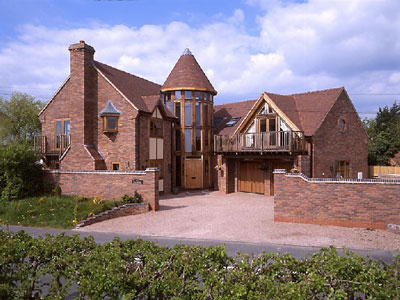

You will find many photos of magnificent buildings built from SIP on the website of the American association of SIP builders, SIPA.
As for “houses for the poor”: a “Pumpkin’s house” can be built from any material. A Canadian house is not for the poor, but for the smart.
Another selection of photos on the topic of ecology, illustrating the installation of a SIP roof on a log house made of pure wood (Eagle Panel Systems, Inc.):
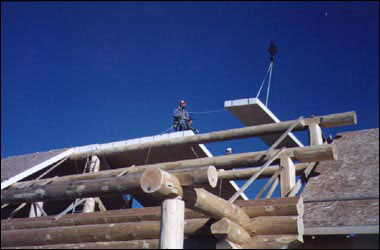
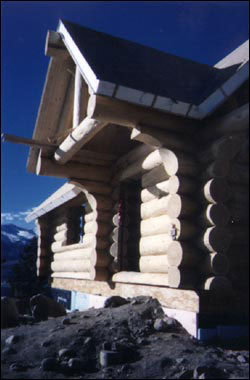
Many claim that Americans build frame houses solely to save money, since the “average” American has no money for brick and wood. Did the client of “Eagle Panel Systems” have only enough money for a log house?
If you want, you can build your own house, garage or renovate an old house yourself, and so on. By purchasing a house kit from us, you receive all the recommendations for construction.
Assembling SIP panels is a complex job, but quite feasible. It is largely because installation is quick and simple that SIP panels have become so widespread. We would like to warn that assembling a house, like building from any other material, requires certain special skills, which our specialists have. But if you have nevertheless decided to assemble the house yourself, you should strictly follow some recommendations:
– You need to know that SIP panels should be installed on a wooden or reinforced concrete frame using special self-tapping screws. Also remember that the length of the mounting screws must be greater than the width of the panel and frame being joined. After assembly, the screw should protrude from the frame by 10 – 20 mm. The joints and ends of the structure that form must be covered with special trim elements, which are also fastened with small self-tapping screws.
– A mandatory step when installing SIP panels is sealing the joints. The most suitable materials for this are polyurethane sealing tape and mounting foam.
– One of the most important stages of installation is cutting the SIP panels. First of all, note that SIP panel installation starts from the corner of the wall. This way, the need to cut panels is reduced to a minimum. Panels should be cut with an electric jigsaw or a reciprocating saw.
As you can see, installing SIP panels is indeed not difficult. It is enough to have certain skills and strictly follow the manufacturer’s recommendations.