In 1845, styrene attracted the interest of the chemists Blyth and von Hofmann: the Englishman and the German carried out their own research and established that the substance turns jelly-like in the absence of oxygen. The chemists called the jelly-like styrene they obtained metastyrene. 21 years later, the French chemist Marcellin Berthelot gave the exact name to the process of styrene thickening: polymerization.
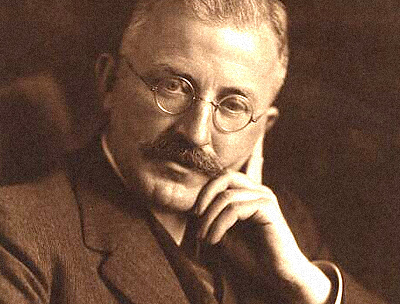
Hermann Staudinger, 1935
In the 20s, the German chemist Hermann Staudinger made an epochal discovery: heating styrene triggers a chain reaction in which long chains of macromolecules form. It was Staudinger's discovery that led to the production of polymers and plastics, for which he received the Nobel Prize in 1953.
The first synthesis of styrene was carried out by researchers at the American company “The Dow Chemical Company”, and commercial production of polystyrene was launched by one of the first companies, “BASF”: in 1930, its engineers developed the technology for producing polymerized styrene. In 1949, the company obtained a patent for producing polystyrene beads expanded with pentane, an idea that originated with chemical engineer Fritz Stastny. On the basis of this patent, in 1951, “BASF” began industrial production of a thermal insulator under the trademark “Styropor”, which is still produced today.
In the USSR, production of expanded polystyrene (grade PS-1) was mastered in 1939, grades PS-2 and PS-4 in 1946, and grade PSB in 1958. In 1961, the USSR mastered the production technology for self-extinguishing expanded polystyrene (PSB-S). Grade PSB expanded polystyrene began to be produced for construction purposes in 1959.