The production process for expanded polystyrene is low in energy use, which contributes to minimal carbon dioxide emissions. The exceptional qualities of styrofoam as a thermal insulator make it one of the first materials to directly contribute to a mass reduction of the greenhouse effect. In the residential sector, styrofoam cuts electricity use, thereby reducing carbon dioxide emissions into the atmosphere. Under the energy emissions control policy pursued in France over the last 25 years, measures taken to insulate homes have reduced carbon dioxide emissions by more than 40 million tons.
How does it affect the ozone layer?
It doesn't: there are no harmful substances in the finished product or in the manufacturing process.
How does it affect air pollution?
Pentane is the only volatile organic compound released during the production of expanded polystyrene. At the same time, its share of the total amount of organic compounds released by the planet is only 0,2%.
At the end of its service life, can expanded polystyrene pollute rivers and groundwater?
Not at all. Even if styrofoam has been in contact with water for a long time, its chemical and bacteriological inertness, as well as its overall stability, guarantee that there will be no changes in the water environment.
Can expanded polystyrene be recycled?
Yes, expanded polystyrene can be recycled in full (100%). After initial shredding, expanded polystyrene is reprocessed until 100% expandable raw material is obtained.
Expanded polystyrene and fire
Like many other building materials and products, expanded polystyrene insulation can ignite. Like all organic substances, expanded polystyrene releases from 1000 to 3000 MJ/kg when it burns. For comparison, burning dry wood releases 7000 — 8000 MJ/m3. Expanded polystyrene therefore causes a negligible rise in temperature compared with the other materials involved in a fire (furniture, linoleum, etc.).
The energy share of expanded polystyrene in a fire is less than 2% of the share of all combustible substances involved in burning a house. The main issue is the correct operation of buildings and structures and compliance with fire safety rules. With the right approach and adherence to these requirements, fire risk is sharply reduced.
To avoid giving in to prejudices of all kinds about expanded polystyrene, we need to turn to the facts. And the facts speak for themselves: over 40 years, expanded polystyrene was unfairly blamed in two serious accidents, and it later turned out the causes were incorrect installation and failure to observe basic fire safety rules. Meanwhile, in Europe since 1960, more than a billion square meters of expanded polystyrene have been used in mansions, cottages and residential buildings.
Below are answers to the most common misconceptions.
Is it true that burning expanded polystyrene releases toxic gases?
All organic chemical materials, including plastics, wood and paper, wool and cotton, release a wide variety of toxic products when burned, including carbon monoxide. In a fire, this is usually the most dangerous gas. Burning the organic materials listed above can also lead to a shortage of oxygen. Knowing the chemical composition and structure of organic materials gives a basis for understanding why smoke and toxic gases form when they burn. Most flammable materials contain carbon, so when they burn they oxidize and release carbon dioxide (CO2). If the oxidation process is not complete enough, carbon monoxide (CO) is released. About 0.3% or 3000 PPM of CO is fatal to humans after 30 minutes of exposure. Polystyrene heated to 300 °C releases only 10 PPM (parts per million) of carbon monoxide; up to 400 °C, only 50 PPM; up to 500 °C, only 500 PPM; and when heated to 600 °C it releases 1000 PPM of carbon monoxide.
Does expanded polystyrene pose a serious danger in a fire?
Obviously, expanded polystyrene is flammable, but unlike many other materials it burns with a visible flame, which makes it possible to notice the fire in time and start fighting it immediately.
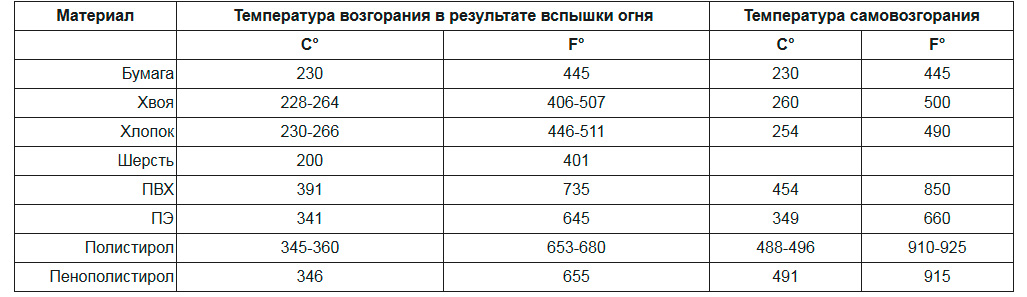
The truth is that expanded polystyrene burns when exposed to a sufficiently strong heat source. A home contains many materials that can ignite at lower temperatures than styrofoam, as shown in the table below. Moreover, to reduce the likelihood of accidental ignition, all expanded polystyrene thermal insulation boards made in Russia for construction purposes contain fire-retardant additives introduced during production.
Below is an excerpt from technical bulletin No. 16 of the company “BASF Styropor” (original source: Carlos J. Hilado, Flammability Handbook for Plastics). It gives a comparative analysis of data on the flash-ignition and self-ignition temperatures of some household materials.
The flash-ignition temperature is the temperature at which vapors form that, mixed with air, can ignite from an external flame source.
The self-ignition temperature is the temperature at which a material smolders or ignites without an external flame source.
Table 1. Ignition temperatures of traditional household materials
How effective are fire-retardant additives?
Adding chemicals helps prevent the material from igniting from small fire sources such as matches or lit cigarettes. This is a very valuable safety factor when handling and installing expanded polystyrene boards.
As is clear, the myths about expanded polystyrene are not just inaccurate, they are false. Improper handling of gas sometimes leads to explosions, but can gas be blamed for that? Carelessness causes thousands of deaths on the roads, but do we stop using vehicles because of it?
Yes, expanded polystyrene is combustible, but wooden structures burn too. In a building, however, expanded polystyrene is always inside the structure, i.e. protected on all sides by concrete, brick or other structural materials, and its share of the total mass of all combustible substances involved in a dwelling fire (wood, polyethylene, cellulose, etc.) is negligible, as is its share of the total amount of harmful substances released in a fire.
According to experts, correct use in compliance with all existing installation, operation and fire safety requirements allows this material to be applied successfully in any structure.
Expanded polystyrene and health
Expanded polystyrene is completely non-toxic and can be used without any concerns. This is also confirmed by the fact that for many years it has been used to make food packaging that comes into direct contact with food. Expanded polystyrene does not contain, and never has contained, chlorofluorocarbons (CFCs) or partially halogenated chlorofluorocarbons (HCFCs).
In construction, too, expanded polystyrene is a safe insulator that can be used without risk and without additional safety measures. Expanded polystyrene contains no hazardous, poisonous or toxic substances, and throughout its use no additional protective equipment (such as respirators or gloves) has been required. Not a single case of occupational disease associated with expanded polystyrene has been recorded.
Expanded polystyrene effectively resists settling (compaction) and guarantees the durability of its thermal insulation properties. After many years of use, styrofoam has also found applications in biology and microbiology, once again proving that it poses no danger to human health.
This is explained by the nature of the foam itself: with its inert structure, expanded polystyrene is biologically neutral and remains stable for many years. In our environment, monomeric styrene occurs in plant resins and in foods such as strawberries, beans, nuts, beer and wine. Containing no gas other than air, expanded polystyrene does not cause allergies or hidden illnesses.
Expanded polystyrene and rodents
Spring and autumn are the periods of most intense rodent breeding. Rodent infestation of buildings increases every year. The reasons for the growth in infestation lie, above all, in the decline in the number of treated premises and areas (industrial enterprises and basements of residential buildings).
Rodents, especially house mice, have long been constant companions of people. There are almost no barriers left on their way to human dwellings. And there is no point in hoping and waiting for rodents to leave on their own. They must be fought, reducing their numbers and not creating conditions for them to enter the home. Rodents, including rats and mice, are sources and carriers of many infectious and parasitic diseases dangerous to humans. So there is no need to fear that mice will eat styrofoam; it is mice, the carriers of terrible diseases, that need to be fought.
But it is worth stressing that the notion that mice threaten houses with expanded polystyrene is no more than a scare story for the overheated imagination of some hysterical citizens. Can a sensible person seriously think that the developers of a technology that has existed for decades did not consider the possibility of mice getting in and did not come up with ways to deal with this nuisance? If this were a problem, the technology simply would not have survived and would not have developed on such a huge scale worldwide.
Judge for yourself. To say that mice eat expanded polystyrene is, to say the least, incorrect. Mice can tunnel through it, but they do not eat it. Why? Expanded polystyrene (PSB-S) is not digested by animals and microorganisms, so it is not used by them as food and does not create a nutrient medium for fungi and bacteria.