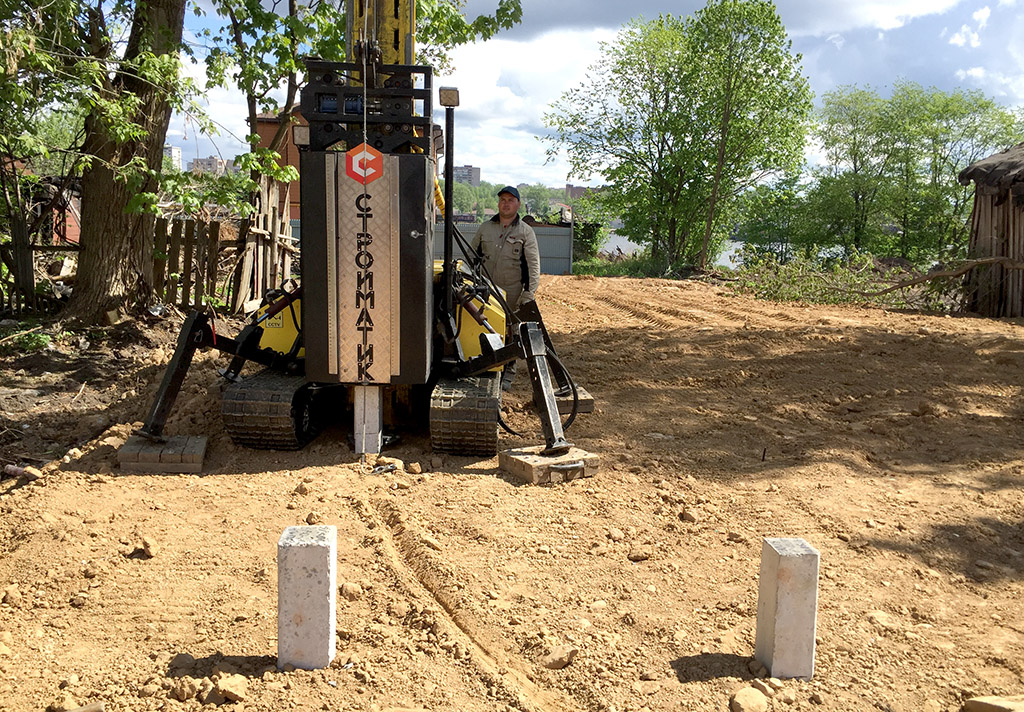
One of the new options being considered for foundations of private houses is driven reinforced concrete piles. Previously, these piles were used only in industrial settings and in permafrost regions for building apartment blocks. Now this kind of foundation is in demand for energy-efficient houses made from SIP panels. Like the construction of the house itself, building the foundation is quick, which is undoubtedly a very attractive factor for clients.
Reinforced concrete piles are rods with a cross-section of 150*150*300. One end of the rod is pointed, like a sharpened pencil. Driven piles are made from heavy grades of concrete. Only high-quality concrete can produce a reliable foundation. The foundation is the base of the house, which is why so much attention is paid to choosing the right technology for each client. Driven reinforced concrete piles are ideal for those whose priority in choosing a foundation is a quick-to-build option on a plot where screw piles cannot be installed, for fear that the steel will corrode in soil with a high water table. Cost is also a key factor in choosing such a foundation.
Installing driven piles has its own specifics compared with installing screw piles, a strip foundation, a Swedish slab…
Reinforced concrete piles are driven into the ground by impact, using special machinery. With every blow to the pile, the base of the pile is strengthened further by compaction of the walls of the hole it forms. The principle behind a driven reinforced concrete pile is that the piles transfer the load from the foundation to the ground. Because the piles are made of concrete, the pile also protects the house from groundwater and flood water.
Driven piles are most often considered as a foundation on weak soils, as well as on soils with a high groundwater level and a tendency to frost heave. A strip foundation cannot be used on such soil, because during use the strip foundation can shift and deform.
In Central Russia — Moscow and Moscow Region, Ivanovo, Kostroma, Yaroslavl, Vladimir, Nizhny Novgorod Region and so on — a driven-pile foundation is considered an alternative to classic foundations when building a cottage from SIP panels. Reinforced concrete piles are not only financially advantageous but also save construction time compared with other options, such as an insulated Swedish slab (USHP) or a strip foundation. Such foundations cost slightly more than screw-pile foundations.
Building a foundation of driven reinforced concrete piles for a SIP panel house involves several stages:
-
Marking out the pile field according to the design of the future house, developed by the SIPwall Design Department, taking the layouts into account and calculating loads specifically for the house being built.
-
The reinforced concrete pile is placed in the head of the pile-driving machine in line with the driving direction;
-
A reinforced concrete pile rod measuring 150*150*3000 is driven into the ground by impact until it stops, as far as it can be pressed in. The load the pile can carry is determined by the dynamic method.
-
The striking part of the machine hits the top of the pile until its lower end is driven to the required level, thereby providing a defined load-bearing capacity for the SIP panel house.
-
With direct impact, the pile sinks to a small depth, increasing the driving depth with each blow. Soil resistance gradually decreases, which increases the load-bearing capacity of the pile.
-
After the piles are driven, they are leveled, in other words cut off. A plate is fixed to the top of the reinforced concrete pile with an anchor, and the grillage of the future SIP panel house is later attached to it.