

30.09.2026
Work Permit in Turkey in 2026: The Employer, Requirements and How It Differs from Digital Nomad
Life in Turkey

Search

Will a Turkish school take your child, what it costs, which documents you need, what denklik is and why your home address decides the school.
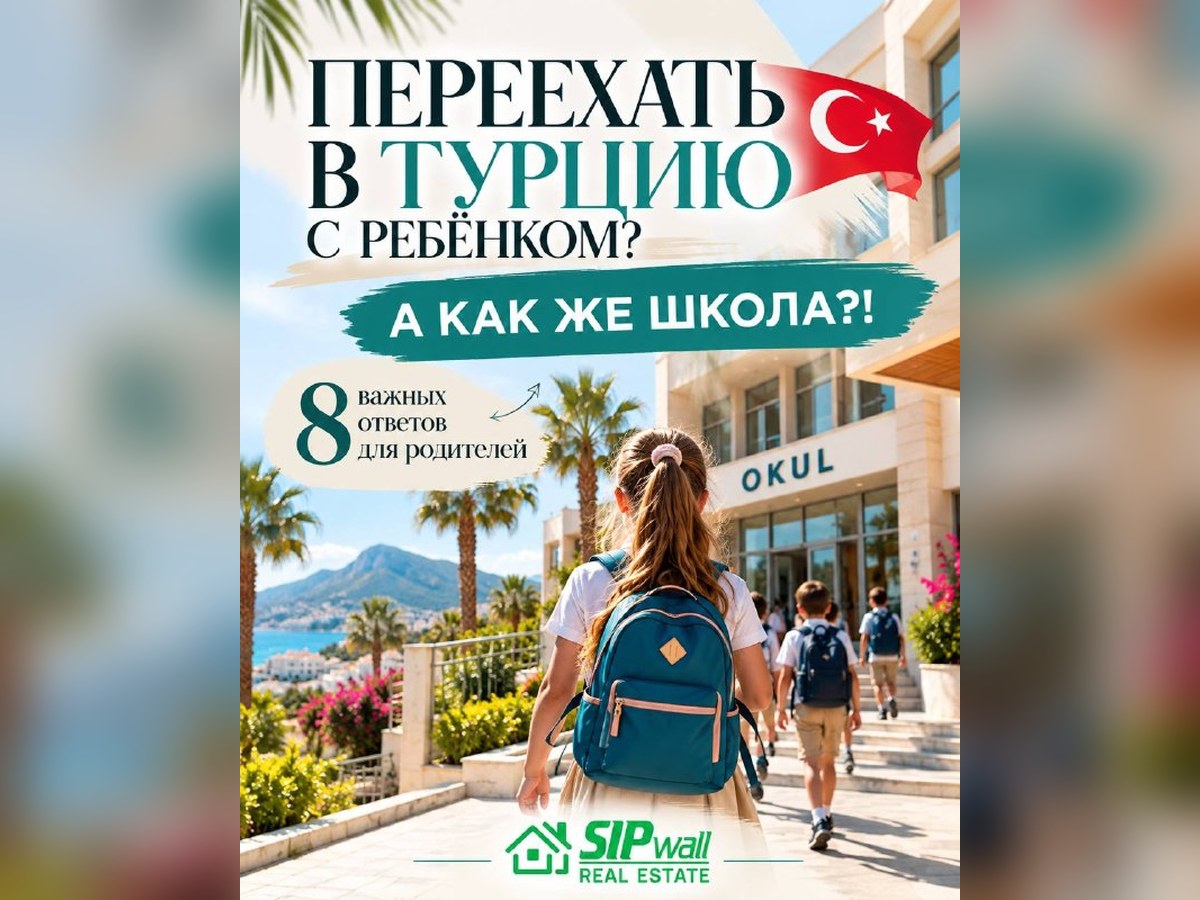
A child from Russia can go to school in Turkey: foreign children study in both state and private schools. But a lot is decided before the move, and some of the rules parents only discover after they have bought a flat. Below is what we checked against Turkish law and the regulations of the Turkish Ministry of National Education (MEB) as of October 2026.
If you would like to talk through your situation, send your child's age, school year and city to our Telegram bot. We will suggest where to start.
In short: yes. Foreign children attend Turkish state schools as long as the family is legally resident. In practice, enrolment requires the child's ikamet (residence permit) with a foreigner ID number and an address recorded in the national address register. Without these two things the school cannot register the child in the electronic system.
Under MEB circular 2014/21, any type of ikamet, or any status that exempts a person from needing one, is enough to enrol a foreign child. The foreigner ID number (YKN) has 11 digits, starts with 99 and is issued together with the ikamet. The school then registers the child in e-Okul, the state electronic system for pupil records.
Which residence permit should your child get? In practice, children usually receive a short-term ikamet together with their parents, on the same grounds. There is also a family residence permit: by law it allows a child to attend school up to the age of 18 without a separate student permit. However, the family permit has its own conditions for the parent, including at least one year of living in Turkey on an ikamet. Which route suits you depends on the grounds for your own permit, so it is best checked before the move.
We do not promise enrolment "on a tourist visa", without an ikamet and a registered address. The 2026 regulation ties enrolment of a foreign child to the foreigner ID number and the address.
In short: there are four options. A state school based on your home address, a private Turkish school, an international school, and studying the Russian curriculum remotely. Many families combine a Turkish school with Russian subjects online, but each option has limits that are worth knowing in advance.
| Option | Programme, cost and key points |
|---|---|
| State school (devlet okulu) | Turkish, MEB curriculum. Tuition is free. The school is assigned by your registered address. |
| Private Turkish school (özel okul, "college") | Turkish plus extended English, MEB curriculum. Paid, fees set by the school. Takes both Turkish and foreign pupils; check the licence. |
| International school (milletlerarası özel okul) | Its own MEB-approved curriculum. Paid. By law only foreign pupils may attend; limited choice in Alanya. |
| Russian curriculum online | Russian, Russian Federation curriculum. Cost depends on the online school. Turkey does not recognise distance learning when a child moves into a local school. |
Private Turkish schools are often called "colleges" (kolej), but this is simply a private school, not a university. The "Turkish school plus Russian language and literature online" approach works well, as long as you understand its limits.
In short: tuition at state schools is free, but parents pay for the uniform, stationery, the school bus and voluntary contributions. At a private school the fee is set by the school itself for a specific academic year, and there is no single price. So ask each school for its 2026/27 fees and compare what is included.
Turkey's Primary Education Law states that primary education in state schools is free. Since December 2024, the uniform in state schools is decided by the school administration, it cannot be changed more often than every four academic years, and under MEB rules it must not place an unnecessary financial burden on the family. The school bus (servis) is paid for separately.
For private schools, only individual examples are available as a guide. A family from Gazipaşa said in August 2026 that they paid about 210,000 lira a year for Year 1 at a private school, excluding textbooks and clubs. Their account does not say which academic year this was, so treat it as one school's example for reference only. Always check what the fee covers: meals, bus, after-school care, textbooks.
If you are choosing a flat with a school in mind, we will shortlist options in areas with schools at the right level nearby and check in advance which school the address belongs to. Send your child's age and your budget to our Telegram bot or browse Property for Sale in Turkey.
In short: Turkey has 12 years of compulsory education on a 4+4+4 model. Children start Year 1 at 5 years and 9 months, earlier than in Russia. That is why a seven-year-old from Russia often ends up in Year 2 by age. Parents can discuss a lower year with the school, especially if the child does not speak Turkish.
The system looks like this:
Children who have reached 69 months, that is 5 years and 9 months, by the end of September are enrolled in Year 1. Children aged 5 years 6 months to 5 years 8 months (66-68 months) are accepted on the parents' written request. If a child arrives without school documents and is going into Years 1-4, a committee decides the year based on age and the parent's application. If documents are available, parents can ask for the child to be placed one year below the level determined when the documents are recognised.
Kindergarten (anaokulu) is optional. State groups give priority to children aged 4 years 9 months to 5 years 8 months, younger children are taken if places remain, and a lottery is held when there are too many applications.
The 2026/27 academic year started on 14 September 2026 and, according to the MEB calendar as reported by Turkish media, runs until 25 June 2027. Pre-schoolers and Year 1 pupils have an adaptation week before the start. Some schools run two shifts and the primary school day can be short, so check the timetable of a specific school in advance.
In short: enrolment goes through e-Okul based on the address recorded in the national address register. The school is determined by where you live, and choosing a school in another area at will is almost impossible. So first you get the ikamet, the foreigner ID number and address registration, and only then enrol your child.
Since late July 2026, amendments to the MEB regulation have fixed enrolment by address. New enrolments open in July, the school is determined by the address in the address register, and to verify it the school may ask for a water, electricity or gas bill. Foreign children are enrolled using the foreigner ID number and the same address. Requests to transfer to a school outside your address that do not meet the conditions are rejected by the system.
If a family arrives in the middle of the academic year, the child can still be enrolled. The MEB regulation specifically covers admission of children who arrive from abroad during the school year. But the ikamet, foreigner ID number and registered address are still needed first.
How to check which school a particular building belongs to, and what else to look at in a flat for a school-age child, we covered in Choosing a Home Near a School in Turkey: 7 Checks.
In short: do the main things in Russia while it is easier: get an apostille on the birth certificate and collect the school records for the last year. The Turkish translation certified by a notary is more convenient to arrange once you are in Turkey. The final list of documents will come from the school at your address or the district education office.
There is no single official MEB list "for foreign pupils". Schools usually ask for:
Russia and Turkey are both parties to the Apostille Convention, so consular legalisation is not needed, an apostille is enough. The apostille on a birth certificate is issued in Russia by the authority of the region where the document was issued. The translation is done by a sworn translator, meaning a translator registered with a notary, and the notary certifies the translation. Turkey's migration service requires exactly this format for documents issued abroad.
It helps to work out the budget for documents, translations and the first months of living in advance. Our guide Budget for Moving to Turkey: How to Calculate It for Your Family covers this.
In short: denklik (recognition of foreign schooling) is Turkey's official recognition of education completed abroad. It is needed if your child has already studied in Russia and is going into Years 2-8 or high school. A Year 1 pupil does not need it. You apply through the e-Denklik system, ideally right after receiving the ikamet.
Recognition is handled by denklik centres at education offices, and applications are submitted through the e-Denklik system. Under the 2024 regulation, denklik is based on original documents: report cards, certificates, transcripts. For primary school, a document for the last year is required.
A few rules from the regulation that should ease some worries:
Note separately: documents from distance learning and from private schools without an MEB licence are not recognised for denklik. Official sources do not state processing times, so start the process without delay.
In short: the year is set by age and documents, and knowing Turkish is not a condition for enrolment. The first months are usually hard, but children start understanding speech quickly. What helps: some Turkish before the move, a tutor, clubs without a Russian-speaking group and regular contact with the teacher.
A 2019 MEB circular provided adaptation classes in Turkish for foreign children in Years 3-12. Whether a particular school in Alanya has such a class is something to ask the school directly. The MEB portal notes that language support is not available in every school and depends on its resources.
A 2025 study by Akdeniz University, a survey of 10 parents of foreign pupils in Antalya schools for the 2020/21 academic year, points to a lack of Turkish lessons and difficulties communicating with teachers. A family from Gazipaşa said their child spoke little Turkish for almost six months while there was a Russian-speaking group around, and then Turkish became the child's main language.
What helps in practice:
In short: yes. Under Russian law this counts as family education with assessments at a Russian school. But Turkish regulations do not recognise distance-learning documents, so when the child moves into a Turkish school the year may be set again from scratch. For a long-term life in Turkey, combining a Turkish school with Russian subjects online is the more reliable option.
Russia's Education Law allows children to study through family education and take assessments at a Russian school. This matters if the family plans to return or wants the child to sit the Russian OGE and EGE state exams.
If a child studies only online for a year or two while living in Turkey, that period may not be counted when they move into a Turkish school. For Years 5-8 a placement exam is possible. That is why we advise families planning to stay long-term to combine the two: a Turkish school plus Russian language and literature online.
In short: ask for the MEB permit to operate a school (kurum açma izin belgesi) and confirm the school's status with the district education office. Documents from an unlicensed school will not be recognised for denklik later. This also applies to centres teaching the Russian curriculum.
Under the Private Education Institutions Law, every school must obtain a permit to open. In 2024 the authorities in Antalya inspected centres that were teaching children the Russian curriculum for Years 1-8 without the required permits, and some were sealed. For a family, this means a risk of closure mid-year and unrecognised documents for the years completed.
How to check:
In short: the address you register at will determine your child's school. So check the school before buying a flat. First decide which school you need, then see which schools the addresses in the area belong to, and only then choose a specific flat.
Because enrolment is by address, the logic of choosing a home for a family with children changes:
Also check whether the mahalle (neighbourhood) accepts address registration for foreigners. The mahalle is the smallest unit of an address in Turkey. In 2022 some mahalles were closed to new registrations by foreigners. In our experience, as of October 2026 the neighbourhoods of Alanya, including Mahmutlar, are open for registration. Difficulties arise more often with a residence permit based on a rental, while after buying a home the address is registered in the usual way. Rules change, so we still check the status of the address as of the date of the deal.
If you are considering an ikamet through buying property, note the threshold: according to the migration service's official list, the property must be worth at least 200,000 USD, and it cannot be rented out. The decision on the ikamet is made by Turkey's migration service. We covered legal residence routes in How to Live Legally in Turkey in 2026: Four Routes. Buying for a residence permit is covered in Buying Property for a Turkish Residence Permit: What You Need to Know. For family-friendly areas, read The Best Areas of Alanya, Turkey, for Families with Children.
In short: documents in Russia first, then legal status and an address in Turkey, then the school, and only after that the final choice of flat. If your child is going into Year 2 or above, start the denklik in parallel. The eight steps below can be done over a few months before the move and the first weeks after it.
This article is for information only and reflects the rules as of October 2026. Decisions on enrolment and recognition of documents are made by the school and the education office, and decisions on residence permits are made by Turkey's migration service. If you would like to find a flat with the right school for your child, message us via our Telegram bot or WhatsApp, phone +90 551 507 90 67.
30.09.2026
Life in Turkey
16.09.2026
Life in Turkey
02.09.2026
For international clients
27.05.2025
Residence Permit and Citizenship

30.04.2025
Life in Turkey

26.11.2024
Residence Permit and Citizenship
Enter your budget and phone — we'll send you a selection with current prices.