


30.09.2026
Work Permit in Turkey in 2026: The Employer, Requirements and How It Differs from Digital Nomad
Life in Turkey

Search

The Digital Nomad route does not suit every remote worker. We look at the official 2026 criteria, the difference between the certificate, the visa and the residence permit, work and income documents, the role of housing and red flags to check before you start.
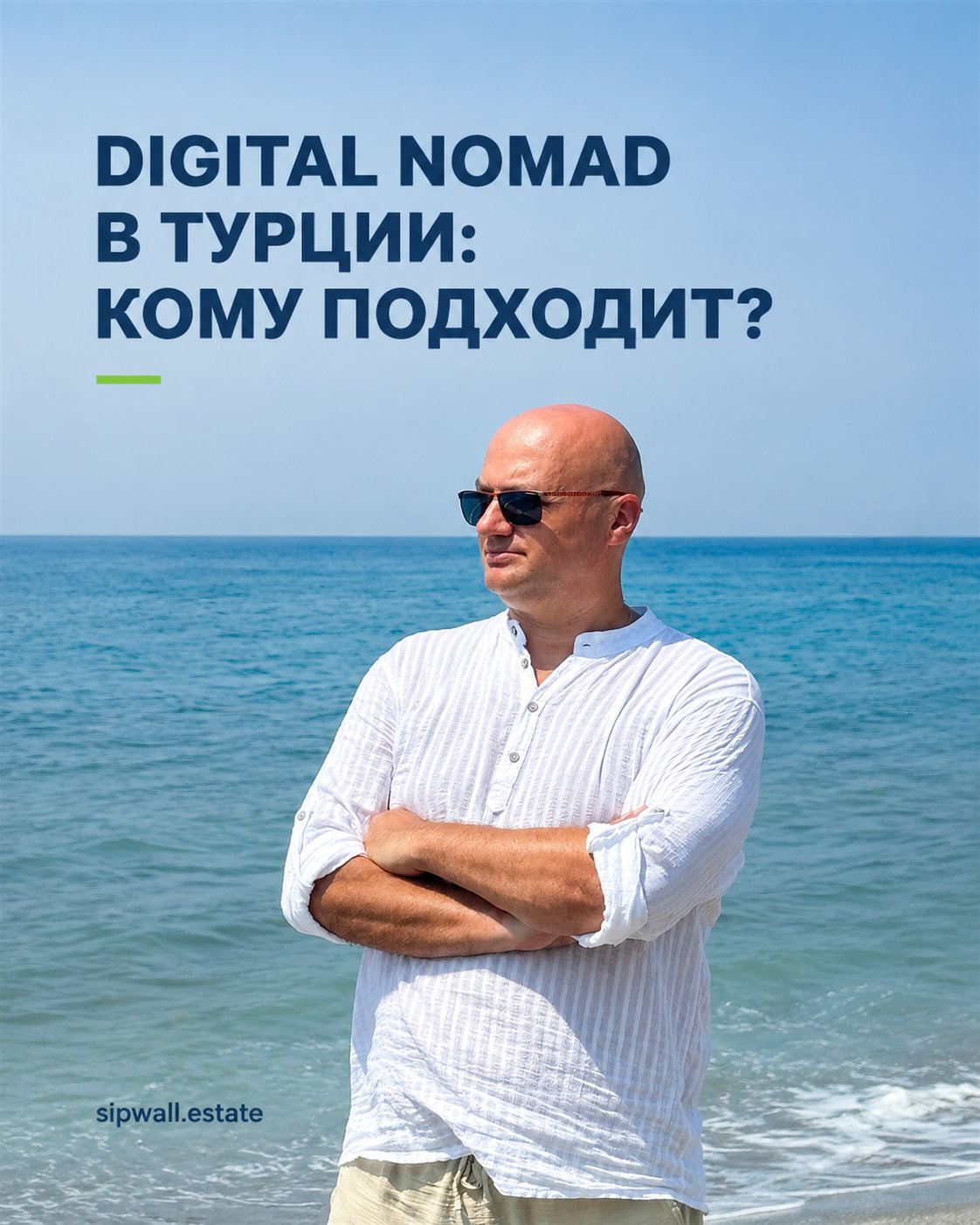
In short: the Digital Nomad route does not suit every remote worker. The official criteria include an age of 21 to 55, a university degree, confirmed work for a company or client outside Turkey, and income of at least 3,000 USD per month or 36,000 USD per year. First you obtain a Digital Nomad Identification Certificate, then you apply for a visa. The certificate does not replace a visa, a residence permit or a work permit for a Turkish company.
Remote work alone does not give you the right to live in Turkey indefinitely. For a legal route, your citizenship, age, education, source of income and the employer's country all matter. If even one criterion cannot be backed up by documents, an attractive programme name will not help.
Below is a step-by-step check for a Russian-speaking applicant, based on official Turkish sources as of 22 August 2026.
The programme is worth considering for someone who actually works remotely for a foreign market and can prove it with documents. Russian citizens are included in the published list of eligible nationalities. Citizens of Belarus and Ukraine are on the same list.
Basic criteria:
The official GoTürkiye platform states that the passport must be valid for at least six months from the date of arrival. At the consular stage, validity requirements may be stricter depending on the intended length of stay, so check your passport before starting the procedure.
If you are still choosing a legal basis, first look at the map of four residence routes in Turkey. It helps you avoid confusing Digital Nomad, the tourist residence permit, the work permit and the property-based residence permit.
This is where confusion most often arises. The route involves different documents and different authorities.
| Document | What it is for | Who reviews it | What it does not automatically give |
|---|---|---|---|
| Digital Nomad Identification Certificate | confirms that you have passed the preliminary check on the platform | GoTürkiye platform | does not replace a visa and does not guarantee entry |
| Digital Nomad Visa | serves as the basis for entry for the stated purpose | Turkish consulate or visa centre | is not a permit to work for a Turkish employer |
| Residence permit | governs residence after entry, where one is required in the specific situation | Turkish Presidency of Migration Management | does not arise automatically from renting a home |
| Work permit | gives the right to work in Turkey under the established conditions | Turkish Ministry of Labour | cannot be replaced by a digital nomad certificate |
The public GoTürkiye guidance explicitly calls the certificate the first step towards a visa application. On the open Migration Management page listing types of short-term residence permit, there was no separate Digital Nomad category as of the date of checking. That is why the sequence of steps after entry and whether a migration filing is needed should be clarified in advance for each specific applicant.
The practical rule is simple: do not pay for a long-term rental or buy tickets based solely on approval of the preliminary application.
The official process consists of two main stages.
The applicant registers on the official Digital Nomads GoTürkiye platform and uploads scans of documents. The platform assesses whether the criteria are met. If the result is positive, a Digital Nomad Identification Certificate or a preliminary form with a QR code is issued.
At this stage you usually need:
After receiving the certificate, the applicant fills in the visa application form on the official portal of the Turkish Ministry of Foreign Affairs, books an appointment and submits documents to the competent Turkish mission or visa centre.
The exact list depends on where you apply. Official consular instructions may additionally require:
That is exactly why a checklist from another country cannot be treated as final. First identify the mission that is authorised to accept your application based on your place of residence, then request its current list.
The weak point of many applications is not the income amount but inconsistent documents. The contract names one company, the money comes from another, the payment reference has nothing to do with the work, and the contract expires in a month.
Before applying, cross-check:
It is better to show income as a clear track record rather than a single random payment. However, the official platform does not publish a universal number of months. The specific statement period should be clarified with the place of application.
The Digital Nomad route is built around work for a company or client outside Turkey. It does not replace a work permit with a Turkish employer.
If you intend to sign an employment contract with a Turkish company, receive a salary from Turkey or effectively work in a local business, you need to check the work permit route separately. Registering your own company also does not turn a digital nomad visa into permission to personally perform work in Turkey.
In the next major article in this series, we will look separately at the work permit, employer requirements and the difference between owning a company and having the right to work.
For a visa application, the consulate may request proof of accommodation. This can be a booking, a rental agreement, an invitation from a host or another document — the list depends on the mission.
For life after entry, the requirements are stricter than for a tourist booking. For a remote professional, the following matter:
Renting an apartment does not guarantee a visa or a residence permit. But an improperly drawn-up contract or an unsuitable address can create additional difficulties. Before paying, it is worth reading how to rent a home in Turkey long term and agreeing the document requirements with a migration specialist in advance.
SIPwall Estate can find a long-term rental or a property to buy that fits your real-life scenario, while a specialist partner checks the migration side.
The official certificate page describes the requirements for the main applicant. It does not promise that a spouse and children will be automatically included in the same certificate or visa.
Before incurring costs, a family needs to determine:
An intermediary's commercial offer to "process a child" is not a government rule. The family file is checked against official requirements and the actual situation.
Do not start by paying for support services if any of the following questions remain unanswered:
Separately check your passport validity, any history of visa refusals, the legality of your current stay and the set of translations. The government authority may request additional documents and makes its decision independently.
Official materials do not give a universal "turnkey" price. Costs may include the consular fee, insurance, translations, notarial services, certificates, travel to the place of application, accommodation and the fees of a support company.
Timelines also depend on the platform, the completeness of the file, appointment availability and the consulate. The official guidance of one Turkish mission states that a visa is processed within up to 30 days after the interview, but this period cannot automatically be applied to Russia, Belarus, Georgia or any other country of application.
A partner's commercial terms are a separate document. Before paying, it should set out the scope of the service, payment stages, the parties' responsibilities, refund terms and a list of expenses payable in addition.
Put together a short questionnaire:
With this information, it is quick to see whether to pursue the Digital Nomad route or first compare another basis.
SIPwall Estate does not issue certificates, visas or residence permits and does not promise any decision by a government authority. Our task is to connect the legal scenario with real life in Turkey.
We help to:
If you are considering Digital Nomad and want to know whether the route suits your family, book an initial review of your situation. Prepare your work and income documents before the consultation so the conversation is specific.
Facts were checked on 22 August 2026 against official Turkish resources:
This article is for information only. Rules, fees, consular document lists and administrative practice change. Before applying, check the requirements of the mission responsible for your place of residence and consult a qualified specialist.
Andrey, SIPwall Estate. Helps Russian-speaking clients connect their relocation goals with the choice of area, a long-term rental or a property purchase in Turkey. Migration and legal matters are referred to specialists in the relevant field.
Planning to buy property in Turkey? We will help you compare regions and properties to suit your goals. Write to us: mail@sipwall.estate
30.09.2026
Life in Turkey

02.09.2026
For international clients

27.05.2025
Residence Permit and Citizenship

30.04.2025
Life in Turkey

26.11.2024
Residence Permit and Citizenship

24.10.2024
Life in Turkey

Enter your budget and phone — we'll send you a selection with current prices.