


21.09.2026
Budget for Moving to Turkey: How to Calculate It for Your Family
Life in Turkey

Search

A photo of a TAPU is not enough to assess a deal. We go through eight checks of the property, the seller, restrictions and payment terms before you pay a deposit.
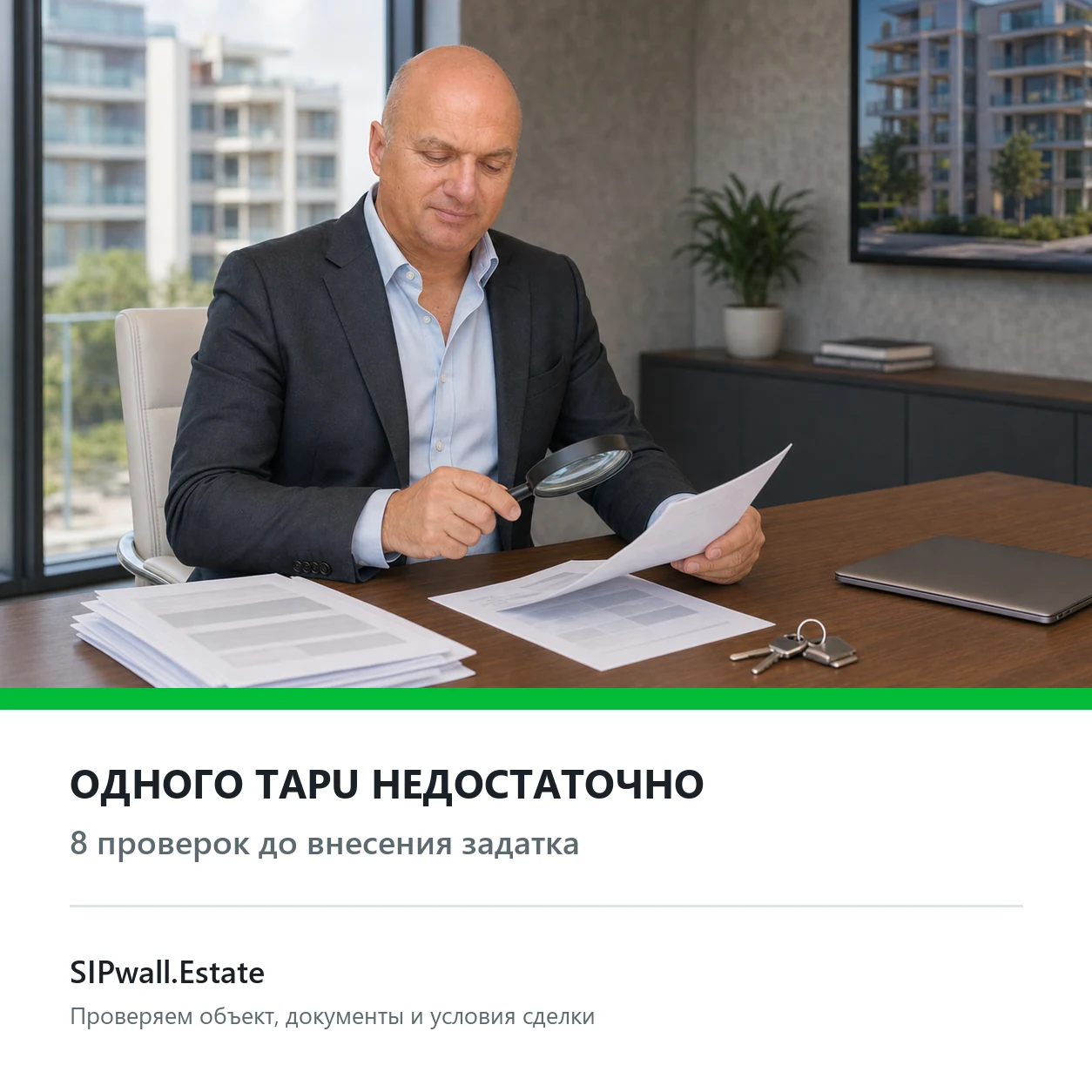
A photo of a TAPU in a chat does not confirm everything that matters to a buyer. It does not show who is entitled to receive the money today, what new entries have appeared in the registry, whether the layout matches the project and whether the payment will be returned if the check reveals a problem.
So the working sequence is: define the purpose of the purchase, request documents for the specific property, verify the data and only then agree on a reservation. Below are eight checks worth carrying out before paying a deposit on property in Turkey.
If you have already chosen a property, at an initial SIPwall.Estate consultation we can draw up a list of documents and determine which questions should be passed on to a Turkish lawyer, an engineer or another relevant specialist.
In short: A TAPU is a document of a registered right to real estate. But a payment decision cannot be made on the basis of a photo or an old copy: you need to match the property against current registry data and check the right holder, authority, restrictions and building documents. The TAPU is the starting point of the check, not a conclusion that the deal is safe.
A buyer usually sees the TAPU already at the selection stage. That is useful: the document helps identify the property and start the check. The mistake happens when a copy is taken as proof that the property is “all clear”.
In the Web Tapu user guide the Turkish land registry TKGM separately shows information such as mortgages, seizures, annotations, declarations, easements and other restrictions. This means you need to look not only at the front page of the document but also at the current entries for the property.
The basic logic of choosing an apartment is covered in the article “Buying an Apartment in Turkey: What to Check Before Paying”. Here we go deeper into the stage between choosing a property and transferring the first payment.
In short: First, the property must be identified unambiguously. Check the province, district, neighbourhood, parcel, block, independent unit number, floor, designation and share of the right. If the apartment shown at the viewing cannot be matched with the documents without guesswork, the reservation should be put on hold until exact data is obtained.
In an advert the property may simply be called “2+1 in a new complex”. That is not enough for a check. Ask for documents for the exact independent unit you are being offered and compare them with the address, the plan and the actual apartment.
An old copy of the TAPU does not fully solve the problem either. New entries may have appeared in the registry between the date it was issued and the negotiations. A practical request to the seller is: “Show me the current registry data for this exact apartment.”
In short: The seller’s name must match the current entry for the right holder. If a representative is acting, their identity, power of attorney, its term and the scope of authority are checked. Being able to show the property or discuss the price does not in itself confirm the right to sign documents, promise a refund or receive money.
Before paying, you need written answers to four questions:
TKGM’s official materials on transactions through a representative require a document confirming the authority. But whether a specific power of attorney is sufficient and whether it includes the right to receive money must be assessed by a Turkish lawyer based on the text of the document, not on an intermediary’s verbal explanation.
In short: An up-to-date check should cover mortgages (
ipotek), seizures or prohibitions (haciz), annotations (şerh), declarations (beyan), easements (irtifak) and othertakyidat. Any entry found must be explained before the deposit: who registered it, whether it affects the deal and how it will be taken into account or removed.
An entry does not always make a sale impossible. But phrases like “it’s a formality” or “we’ll remove it on the day of the deal” are not enough. You need a clear procedure, documents, a responsible party and a deadline.
If removing a restriction depends on a bank, creditor, court or another party, this should be tied to the stages of the contract and payments. The buyer must understand what will happen if the promised action is not completed on time.
In short: A property advertised as an apartment may have a different registration or construction status. Before the deposit you need to check the designation, the independent unit and the type of registered right, including the differences between
kat mülkiyetiandkat irtifakı. The status is then compared with the buyer’s goal.
The legal ability to buy a property and the suitability of the property for your goal are not the same thing. An apartment may be suitable for seasonal stays but require a separate assessment for permanent living, renting, business, redevelopment or a migration scenario.
That is why it is better to write down the goal before the reservation: your own residence, holidays, renting out, resale, residence permit or citizenship. Starting with the goal rather than an attractive picture is also easier with our breakdown of three typical buyer mistakes.
In short: For a completed property, the building permit (
yapı ruhsatı), the occupancy permit (yapı kullanma izin belgesi, or İSKAN), the approved project and the actual condition of the apartment are checked separately. The TAPU and İSKAN do not replace a technical inspection and do not automatically legalise layout changes.
Enclosed balconies and terraces, merged rooms, relocated wet areas, extensions and changed entrances require special attention. A beautiful renovation does not prove that the changes were approved.
If the documents and the actual condition differ, you need to understand the consequences before paying: whether the situation can be corrected, who does it, how long it will take and whether the buyer has the right to withdraw. The structure, quality of work and safety of the building are assessed by a qualified engineer.
The DASK policy is checked separately when the property is subject to compulsory insurance. Law No. 6305 links a valid policy to the relevant registration transactions, but having DASK is not a conclusion on the building’s earthquake resistance.
In short: Before the deposit you should request information on aidat, debts to the management body, municipal charges, utility bills and other regular expenses. For rentals, management, insurance, repairs and vacancy are also calculated. A verbal “there are no debts” is not enough — confirmation and the calculation date matter.
The deal document should specify:
The exact set of certificates depends on the property, the complex and the municipality. If the apartment is bought for renting out, you should assess the net result after expenses, not just the promised gross rate.
In short: For a foreign buyer, citizenship, the location and category of the property, territorial and quantitative restrictions and other conditions of the specific deal are checked. A conclusion reached for one buyer or a neighbouring apartment cannot automatically be transferred to another situation. The stated purpose of the purchase is assessed separately.
TKGM publishes guides on the acquisition of property by foreigners, but documents and restrictions must be re-checked as of the date of the deal.
The phrase “a foreigner can buy it” does not mean the property qualifies for a residence permit or citizenship. These are different checks with different conditions. This article deliberately does not cite thresholds or promise a result: a migration or investment scenario must be checked separately for the buyer, the property, the valuation and the payment structure.
If the property is chosen primarily for relocation, it is helpful to define your living scenario first. The article “Why People Choose Turkey for Living: More Than a Seaside Apartment” helps you formulate requirements for the district and the property before viewings.
In short: A payment should not replace agreements. Before transferring money, the document records the property, the parties, the amount, the currency, the price, the reservation period, the seller’s obligations and the conditions for checks and refunds. The legal consequences of the words “earnest money”, “advance”, “deposit” and “reservation” depend on the document and must be checked by a Turkish lawyer.
Minimum list of terms:
The sale of real estate and a promise to sell are subject to formal requirements. That is why transferring money to bank details received in a messenger cannot be regarded as proper documentation of a purchase. The form of the document, the refund wording and the recipient’s authority must be checked before paying.
For the main payment, TKGM describes the official mechanism Güvenilir Hesap: funds are blocked until registration and transferred to the seller afterwards. Whether this or another banking route suits a specific deal should be clarified in advance.
Do not transfer money until significant uncertainties have been resolved. Reasons to pause the process:
A pause does not automatically mean giving up the property. It restores the correct sequence: documents and terms first, money second.
An agency can collect the initial data, match the property with the client’s goal and organise the process. A legal opinion on documents, the contract and restrictions must be given by a specialist licensed to practise in Turkey. The technical condition and consequences of redevelopment are assessed by an engineer.
SIPwall.Estate does not replace these specialists. The scope of support is defined for each specific deal: what the team checks and what is passed on to a lawyer, notary, engineer, bank or municipality. A separate service is real estate transaction support.
Before paying a deposit, you should have answers to eight questions:
A TAPU is needed to start the check, but one copy is not enough to decide on a deposit. A buyer needs to check the property, the owner, authority, restrictions, building documents, the layout, debts, whether a foreigner can make the purchase and the terms for refunding the money.
If you already have a property or the seller’s documents, request a review of your situation from SIPwall.Estate. The team will help you build a checking route and bring in relevant specialists where a legal or technical assessment is required.
Important: this material is for information only and is not an individual legal, tax, investment or migration opinion. Requirements and documents must be re-checked as of the date of the specific deal.
Planning to buy property in Turkey? We will help you compare regions and properties for your goals. Write to us: mail@sipwall.estate
21.09.2026
Life in Turkey
11.09.2026
Choosing a property

09.09.2026
Useful Tips for Buyers

01.09.2026
Life in Turkey

22.08.2026
Choosing a property

12.08.2026
Choosing a property

Enter your budget and phone — we'll send you a selection with current prices.